
Growing Spine
Hidden blood loss in patients undergoing segmental pedicle screw instrumentation for syndromic scoliosis and predictors for bleeding: a case-control study
- Turku University Hospital, Turku, Finland
- University of Helsinki and Helsinki University Hospital, Helsinki, Finland
Abstract
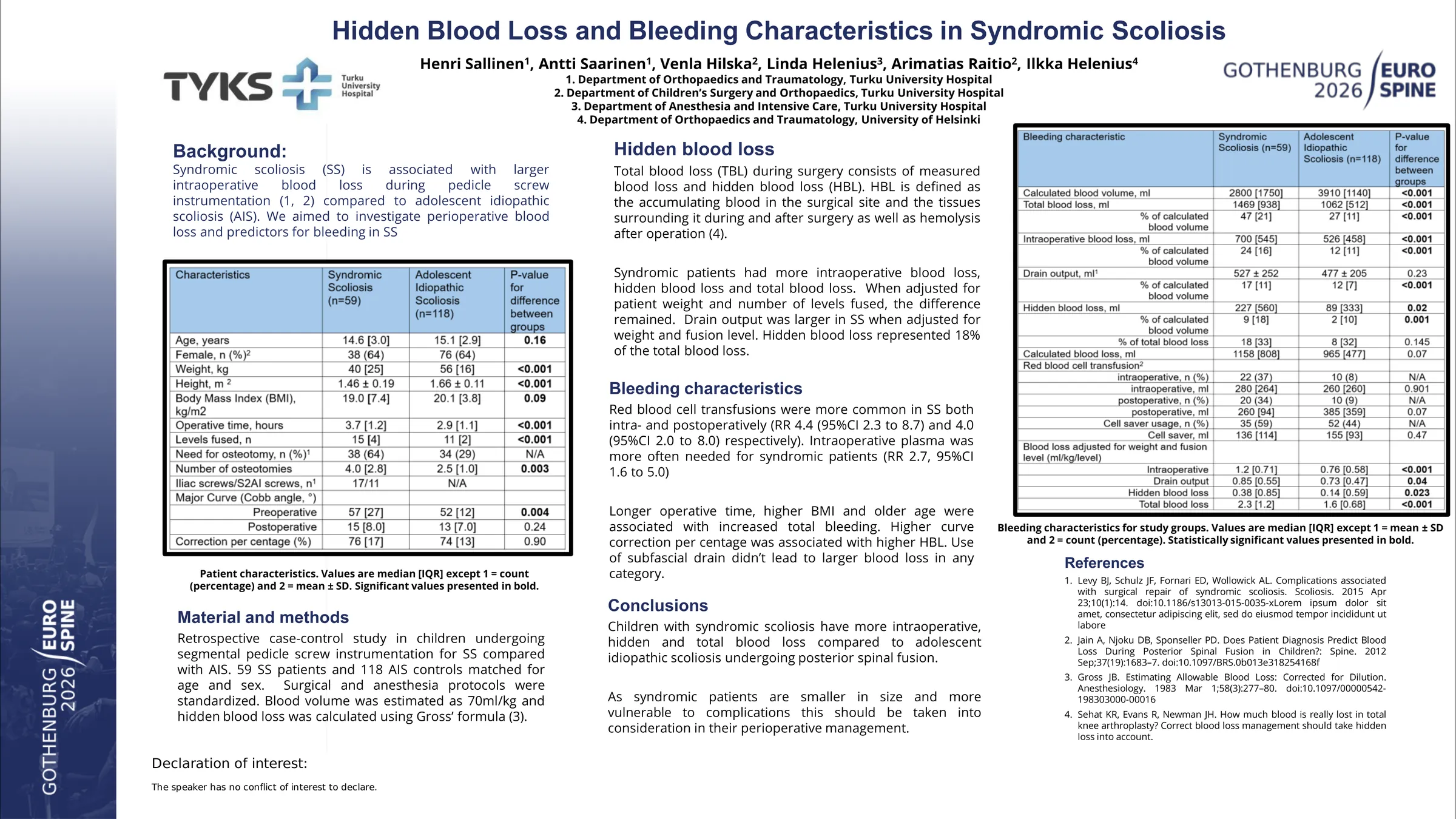
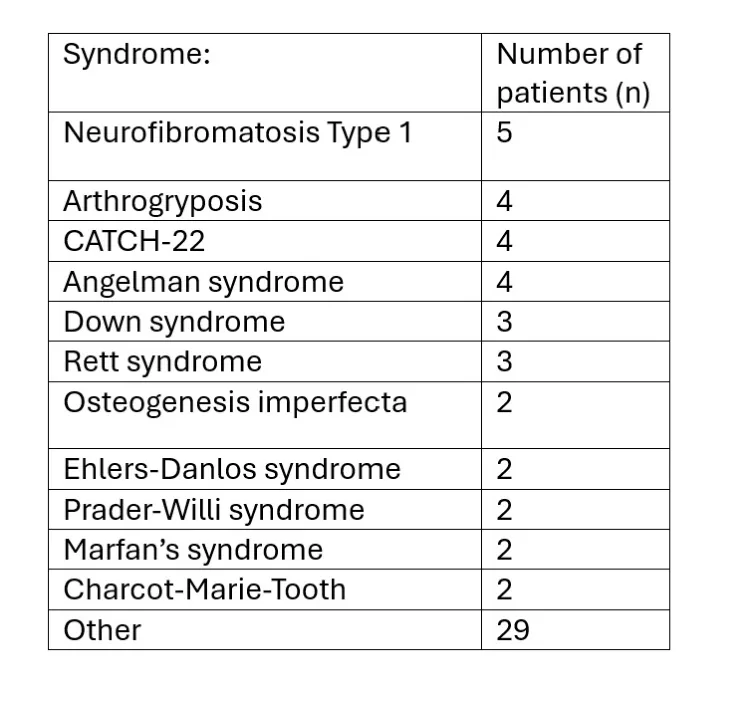
Syndromic scoliosis (SS) is associated with an underlying condition and the incidence of scoliosis in this group is significantly higher than in the general population. Patients with SS typically have large, progressive curvatures that often require surgery. SS is associated with larger blood loss during deformity correction with segmental pedicle screw instrumentation compared to adolescent idiopathic scoliosis (AIS). Total blood consists of measured i.e. intraoperative or drain output, and blood loss not visualized (defined as hidden blood loss). The latter represents up to 30% of the total blood loss in patients undergoing instrumented posterior spinal fusion for AIS while evidence for SS is lacking. We aimed to investigate the total and hidden blood loss for SS and potential predictors for blood loss.
A retrospective case-control study in children undergoing segmental pedicle screw instrumentation for SS between 2009 and 2025. For each SS patient, 2 controls with AIS were matched for sex and age. All patients were identified in the institutional pediatric spine register.
62 SS patients (median age 14.9 years [IQR 2.8]) and 124 AIS patients (15.1 years [3.0] were included. 38 SS patients were female (62%). Total bleeding and measured blood loss were larger for SS (1520 ml [IQR 950] vs. 1050 ml [480], p <0.001 and 1190 ml [770] vs. 940 ml [600], p = 0.006, respectively). No difference was evident regarding HBL (170 ml [650] vs. 80 ml [470], p=0.118). Operative time and number of levels fused were larger in SS (p<0.001). No significant difference was observed when adjusting total, hidden or measured blood loss for operative time (p=0.17, p=0.24 and p=0.70 respectively). Longer operative time, older age and larger size of erythrocytes were associated with larger total blood loss in SS (p<0.05 for all correlations). Hidden blood loss was inversely correlated with longer operative time (rs = -0.47, p<0.001).
Total and measured blood loss was higher in SS compared to AIS. Hidden blood loss was similar in the study groups and represented 11% of total bleeding in SS. Longer operative time, older age, and larger erythrocyte size were associated with larger total blood loss.
Figures and tables
![Table 1. Patient characteristics. All values are median [IQR]](../../abb/000729-1-zoom.webp)
As submitted with the abstract. Tap a figure to open it at full size.