
Degenerative Thoracolumbar
Clinical outcomes after decompression followed by fusion versus primary fusion for lumbar degenerative spondylolisthesis: an analysis of propensity score-matched registry data
- Schulthess Clinic, Zurich, Switzerland
Abstract
In lumbar degenerative spondylolisthesis, the optimal initial surgical approach remains debated. While fusion provides immediate stabilization, decompression-only surgery may suffice for selected patients, potentially avoiding the morbidity and cost of fusion. Some patients eventually require a fusion after the initial decompression. Whether those patients have a compromised long-term outcome compared with primary fusion is unknown. This registry study compared the clinical outcomes of patients who underwent fusion after having previously undergone decompression versus those who received primary fusion.
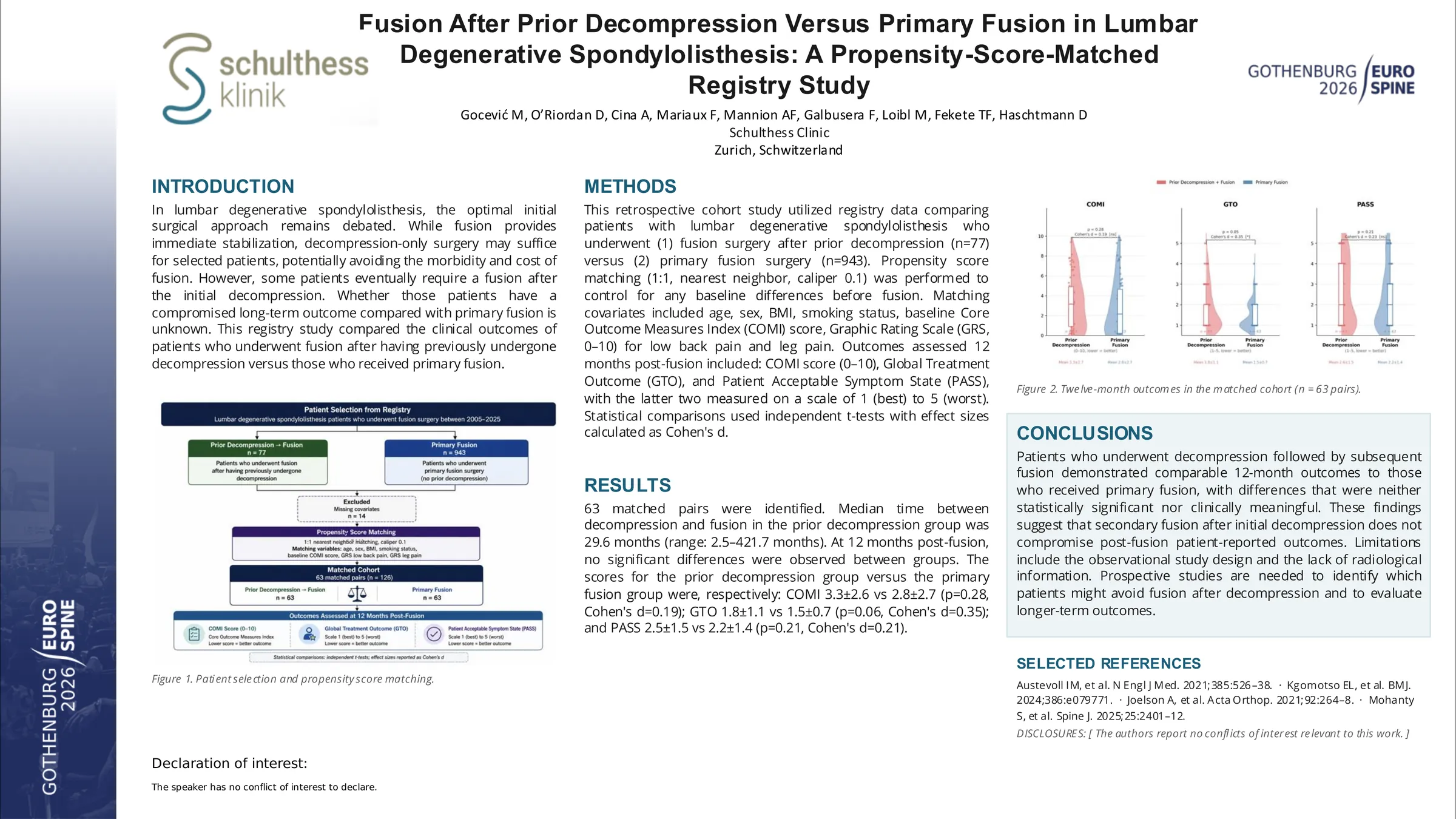
This retrospective cohort study utilized registry data comparing patients with lumbar degenerative spondylolisthesis who underwent (1) fusion surgery after prior decompression (n=63) versus (2) primary fusion surgery (n=943). Propensity score matching (1:1, nearest neighbor, caliper 0.1) was performed to control for any baseline differences before fusion. Matching covariates included age, sex, BMI, smoking status, baseline Core Outcome Measures Index (COMI) score, Graphic Rating Scale (GRS, 0-10) for low back pain and leg pain. Outcomes assessed 12 months post-fusion included: COMI score (0-10), Global Treatment Outcome (GTO), and Patient Acceptable Symptom State (PASS), with the latter two measured on a scale of 1 (best) to 5 (worst). Statistical comparisons used independent t-tests with effect sizes calculated as Cohen's d.
63 matched pairs were identified. Median time between decompression and fusion in the prior decompression group was 29.6 months (range: 2.5-421.7 months). At 12 months post-fusion, no significant differences were observed between groups. The scores for the prior decompression group versus the primary fusion group were, respectively: COMI 3.3±2.6 vs 2.8±2.7 (p=0.28, Cohen's d=0.19); GTO 1.8±1.1 vs 1.5±0.7 (p=0.06, Cohen's d=0.35); and PASS 2.5±1.5 vs 2.2±1.4 (p=0.21, Cohen's d=0.21).
Patients who underwent decompression followed by subsequent fusion demonstrated comparable 12-month outcomes to those who received primary fusion, with differences that were neither statistically significant nor clinically meaningful. These findings suggest that secondary fusion after initial decompression does not compromise post-fusion patient-reported outcomes. Limitations include the observational study design and the lack of radiological information. Prospective studies are needed to identify which patients might avoid fusion after decompression and to evaluate longer-term outcomes.