
Degenerative Thoracolumbar
Good Patient-Reported Outcomes after Full-Endoscopic Lumbar Discectomy: A Retrospective Follow-Up Study
- Dept of Orthopedics, Inst of Clinical Sciences, Gothenburg University, Gothenburg Sweden, Gothenburg, Sweden
- Dep of Orthopedics, Inst of clinicla sciences, Gothenburg University, Gothenburg, Sweden, Gothenburg, Sweden
- Sahlgrenska University Hospital, Gothenburg, Sweden, Sweden
Abstract
Sciatica and low back pain due to lumbar disc herniation are common health issues. Although most benefit from conservative treatment, approximately 2000 patients in Sweden annually require surgery. Full-Endoscopic Lumbar Discectomy (FELD) is a truly minimally invasive procedure. This surgical method minimizes operating time, reduces risks and hospital stays while offering pain relief and disability reduction at least as effective as traditional methods.
This study aims to retrospectively follow up 245 patients who have had an elective FELD procedure.
245 patients who underwent FELD at Sahlgrenska University Hospital or Carlanderska Hospital, Gothenburg, Sweden was included in this study. The patients were asked to answer the questionnaires EuroQol-5 Dimensions (EQ5D), Oswestry Disability Index (ODI), Numerical Rating Scales (NRS), and Global Assessment, which are included in Swespine. The preoperative PROMs, as well as those at three months, one-, two-, and five years postoperatively, were then analyzed.
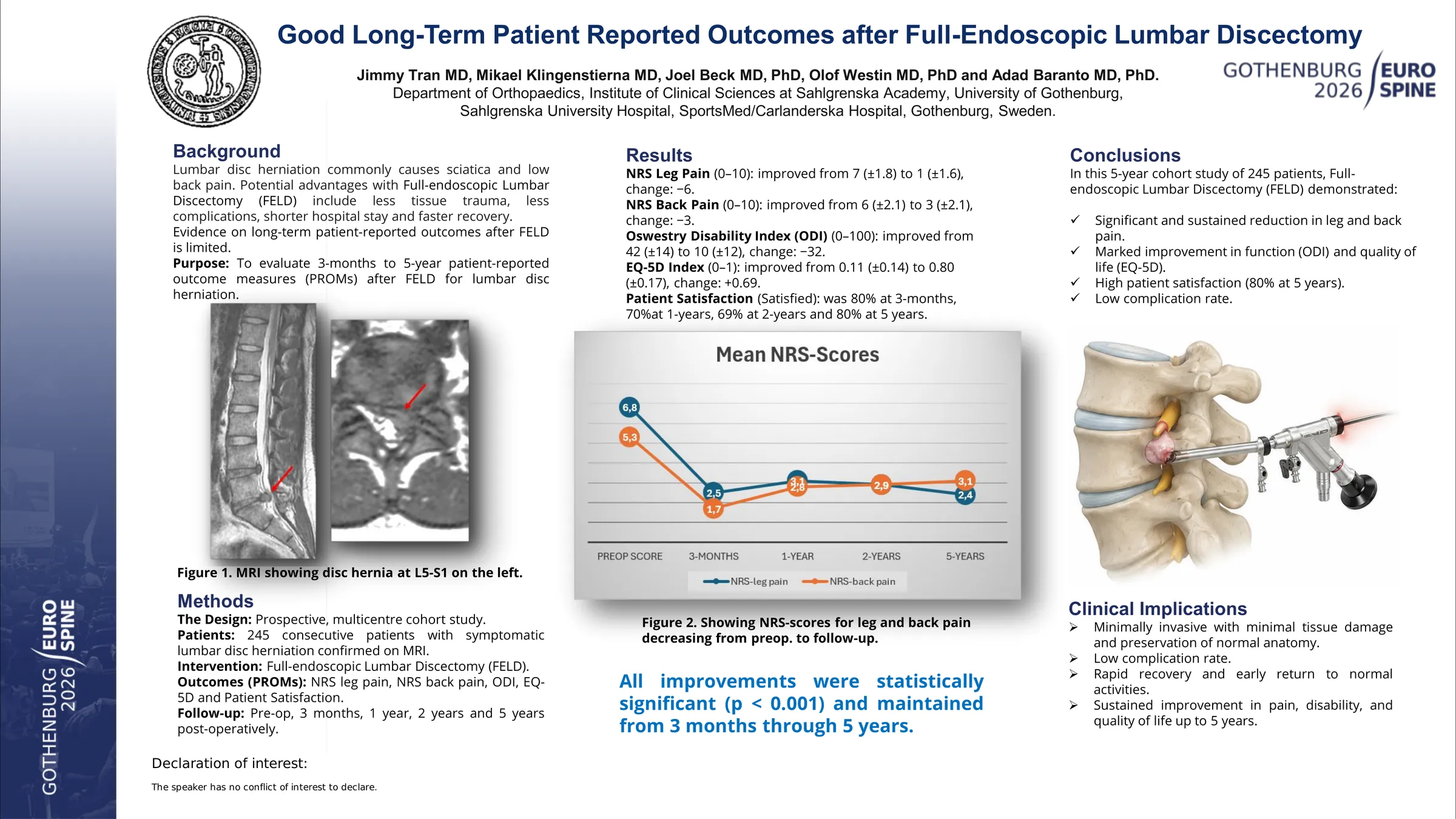
FELD significantly reduced leg pain, back pain, disability (ODI), and improved quality of life (EQ5D) with sustained effects over five years. Median NRS leg pain decreased from 7 preoperatively to 1 at three months, 2 at one- and two-years, and to 1 at the five-year follow-up (p < 0.001). NRS back pain dropped from 6 to 1 at three months (p < 0.001) and ended at 3 at the five-year follow-up. ODI decreased from 42 to 10 at three months and remained stable over the years (p < 0.001), while EQ-5D improved from 0.11 preoperatively to 0.80 at the five-year follow-up (p = 0.001).
FELD is an effective procedure for treating radicular leg pain, improving functional outcomes, and enhancing quality of life up to 5 years. Further research is required to explore the relationship between symptom duration and surgical outcomes.