
Degenerative Thoracolumbar
Fusion-Avoiding Unilateral Biportal Endoscopic Decompression for Lumbar Juxta-Facet Cysts: Ipsilateral vs Contralateral Corridor Comparison
- Suncheon Hana Hospital, Suncheon, Korea, Republic of
- Kyungpook National University Hospital, School of Medicine, Kyungpook National University, Daegu, Korea, Republic of
Abstract
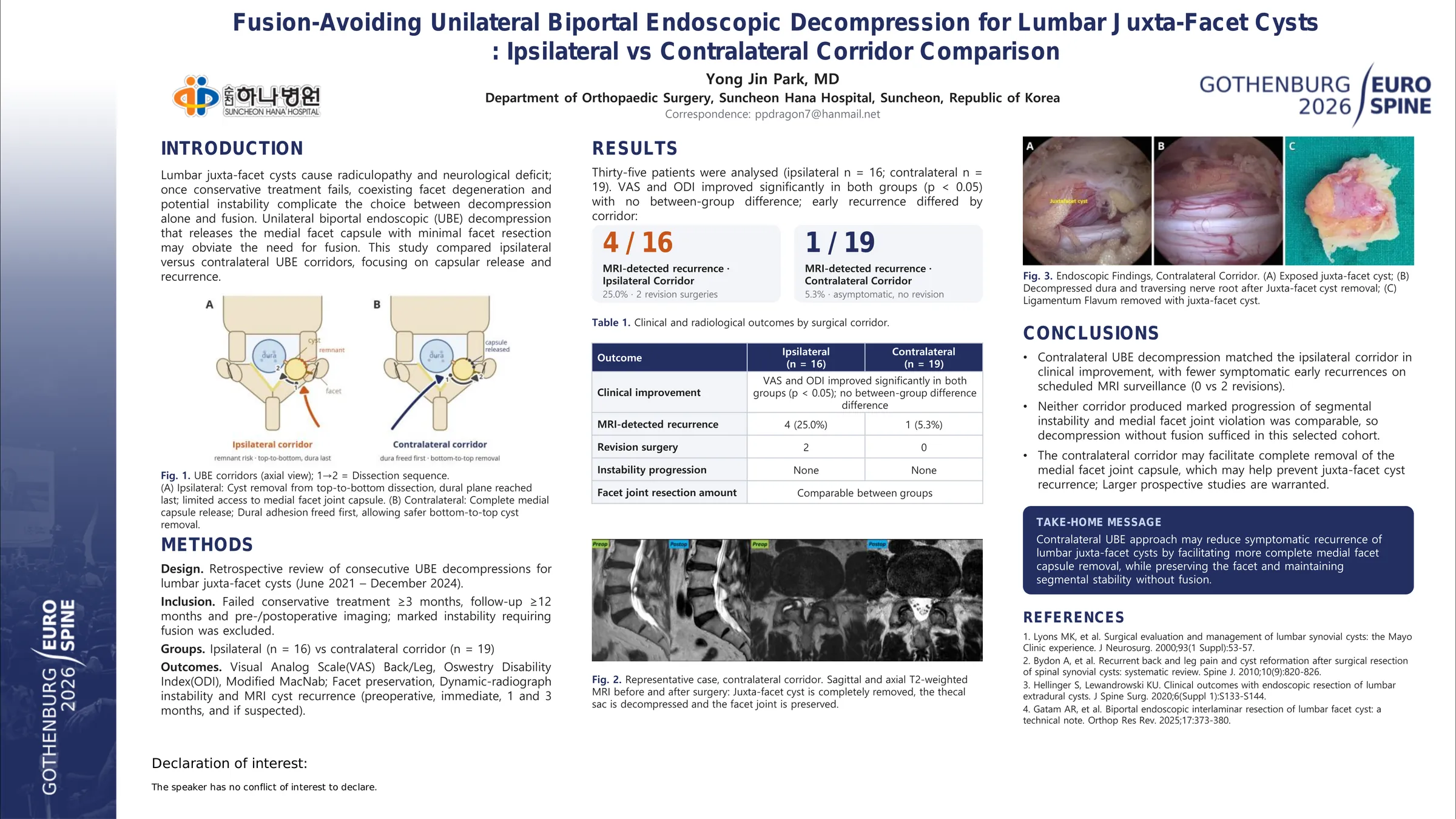
Lumbar juxta-facet cysts are degenerative lesions that can produce radiculopathy and neurological deficits. Surgical decompression is indicated after failure of conservative treatment; however, the frequent association with facet degeneration and potential instability complicates the decision between decompression alone versus fusion. An endoscopic technique that achieves complete decompression through medial facet capsular release while minimizing facet resection is therefore clinically meaningful and may obviate the need for fusion. This pilot study compared ipsilateral versus contralateral unilateral biportal endoscopic (UBE) decompression for lumbar juxta-facet cysts.
We retrospectively reviewed consecutive patients who underwent UBE decompression for lumbar juxta-facet cysts between June 2021 and December 2024. Inclusion criteria were: (1) failed ≥3 months of conservative management, (2) minimum 12-month follow-up, and (3) available pre- and postoperative imaging. Patients with marked preoperative instability requiring fusion were excluded. Patients were grouped by surgical corridor: ipsilateral approach versus contralateral approach. Outcomes included VAS (back/leg), ODI, and modified MacNab criteria. Radiologic assessments included facet preservation on postoperative imaging, progression of instability on dynamic radiographs, and cyst recurrence. MRI was obtained preoperatively, immediately postoperatively, and at 1 and 3 months; additional MRI was performed when recurrence was clinically suspected.
Thirty-five patients met inclusion criteria (Ipsilateral approach, n=16; Contralateral approach, n=19). Both groups demonstrated significant postoperative improvement in VAS and ODI compared with baseline (p<0.05), with no between-group differences in clinical improvement. Early MRI-detected recurrence occurred more frequently after ipsilateral approach. In the ipsilateral approach group, four patients showed recurrence; two required revision surgery due to recurrent symptoms. In the contralateral approach group, one patient had MRI evidence of recurrence but remained asymptomatic and did not require revision. No patient in either group demonstrated marked progression of segmental instability on follow-up dynamic radiographs. The degree of postoperative facet joint damage was comparable between groups.
In this pilot comparative study, contralateral UBE decompression achieved effective clinical improvement and demonstrated a lower rate of symptomatic recurrence on early MRI surveillance, without marked progression of instability. The contralateral corridor may provide technical advantages for complete medial facet capsule removal while limiting facet compromise. Larger prospective studies are warranted to validate recurrence and stability outcomes.