
Trauma
Effects of Sarcopenia on Osteoporotic Vertebral Fracture Occurrence
- Seoul St. Mary's Hospital, The Catholic University of Korea, Seoul, Korea, Republic of
Abstract
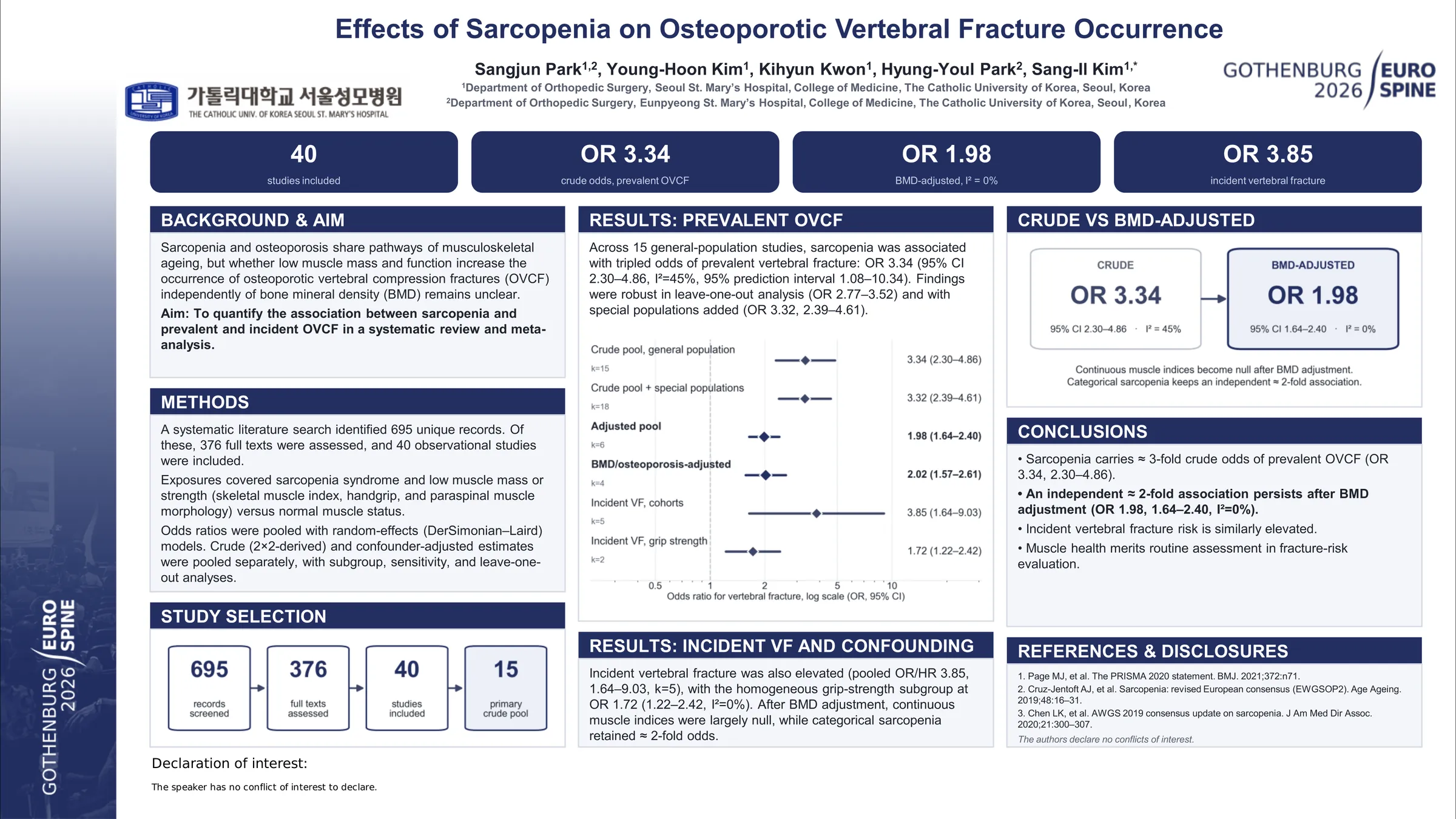
Sarcopenia has emerged as a potential risk factor for vertebral fractures, yet its independent contribution remains unclear due to confounding from concurrent osteoporosis and obesity. This systematic review and component network meta-analysis aimed to evaluate the independent and combined effects of sarcopenia, osteoporosis, and obesity on vertebral fracture occurrence.
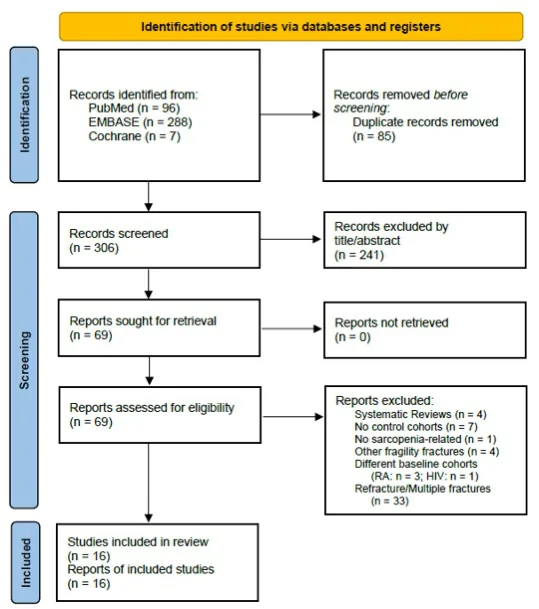
PubMed, EMBASE, and Cochrane Library were searched through January 2026 for observational studies examining sarcopenia and vertebral fracture risk in adults. Studies focusing on refracture after vertebral augmentation, other fragility fracture sites, or specific disease cohorts (rheumatoid arthritis, HIV) were excluded. Studies were categorized by exposure: sarcopenia only (S), osteoporosis only (O), osteosarcopenia (S+O), sarcopenic obesity (S+Ob), and osteosarcopenic obesity (S+O+Ob). Random-effects meta-analysis was performed for each exposure category. Component network meta-analysis using weighted least squares regression decomposed combination exposures into independent component effects under an additive model. Publication bias was assessed using Egger's test, Begg's test, and trim-and-fill analysis.
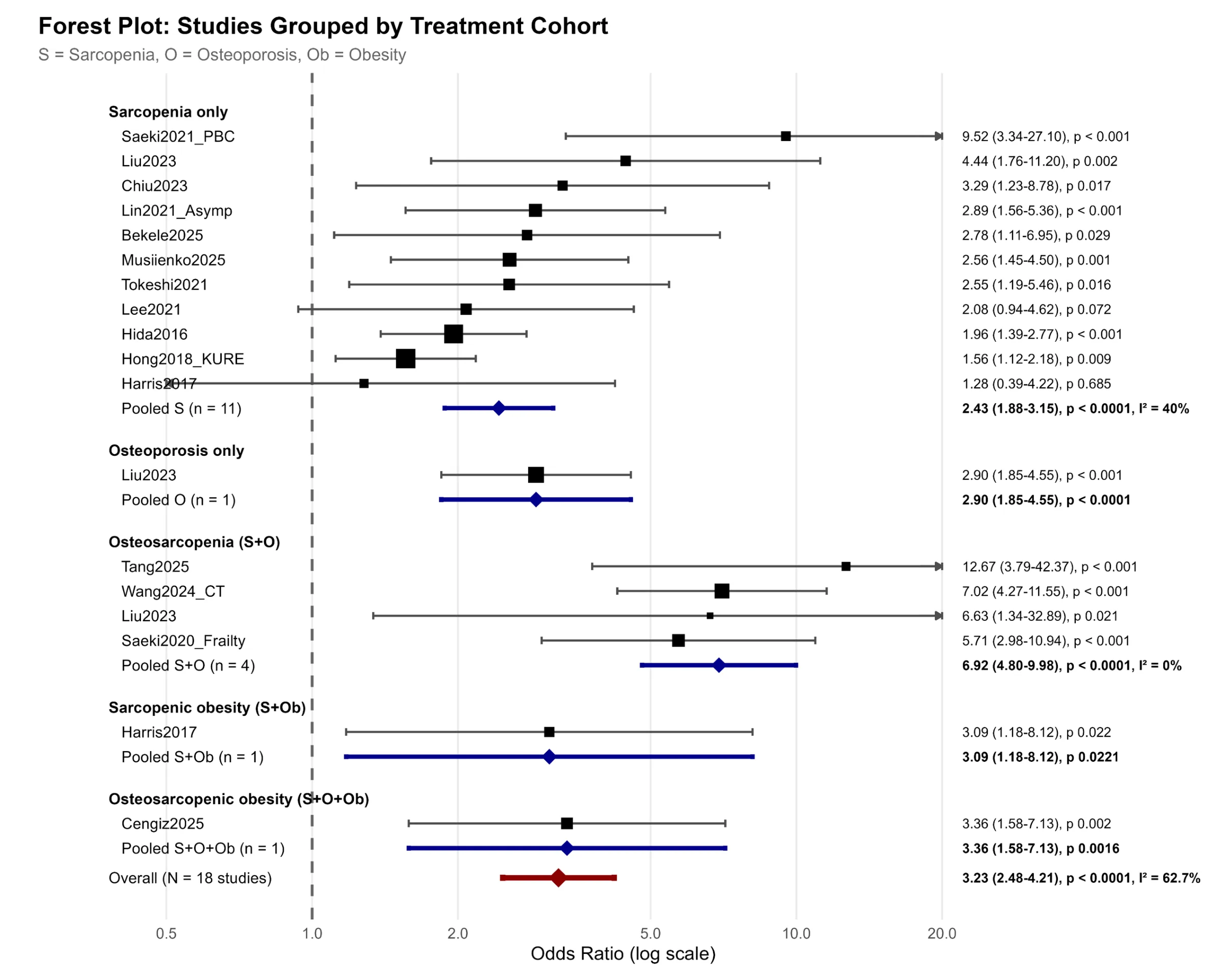
Sixteen studies met inclusion criteria. Pooled analysis revealed significant associations for sarcopenia alone (OR=2.43; 95% CI: 1.88–3.15; I²=40%), osteoporosis alone (OR=2.90; 95% CI: 1.85–4.55), and osteosarcopenia (OR=6.92; 95% CI: 4.80–9.98; I²=0%). Component network meta-analysis estimated independent effects of sarcopenia (OR=2.58; 95% CI: 1.91–3.48; p<0.0001) and osteoporosis (OR=2.61; 95% CI: 1.59–4.29; p=0.0002), while obesity showed no significant independent effect (OR=0.73; 95% CI: 0.31–1.73; p=0.47). Predicted combination effects aligned with observed values, supporting the additivity assumption. Egger's test indicated funnel plot asymmetry (p=0.032), though trim-and-fill analysis imputed no additional studies.
Sarcopenia and osteoporosis are independent risk factors for vertebral fractures with approximately equal and additive effects, resulting in a nearly seven-fold increased risk when combined as osteosarcopenia. Obesity does not independently contribute to vertebral fracture risk. These findings support concurrent assessment and management of both muscle and bone health in fracture prevention strategies.
Figures and tables
As submitted with the abstract. Tap a figure to open it at full size.