
Tumours & Infection
Full-Endoscopic Access–Assisted Continuous Local Antibiotics Perfusion (FESS-assisted CLAP) for Native Pyogenic Spondylodiscitis: Technique and Early Experience
- Katori Omigawa Medical Center, Katori, Japan
Abstract
Native pyogenic spondylodiscitis remains challenging to eradicate. Systemic antibiotic penetration into the disc space is limited. Persistent infected tissue may prolong inflammation and symptoms . Continuous local antibiotics perfusion (CLAP) is increasingly used in bone/soft-tissue infections. In spine surgery, CLAP reports have mainly focused on postoperative SSI. We explored CLAP combined with full-endoscopic access for native disease. This abstract describes the technique and early clinical outcomes.
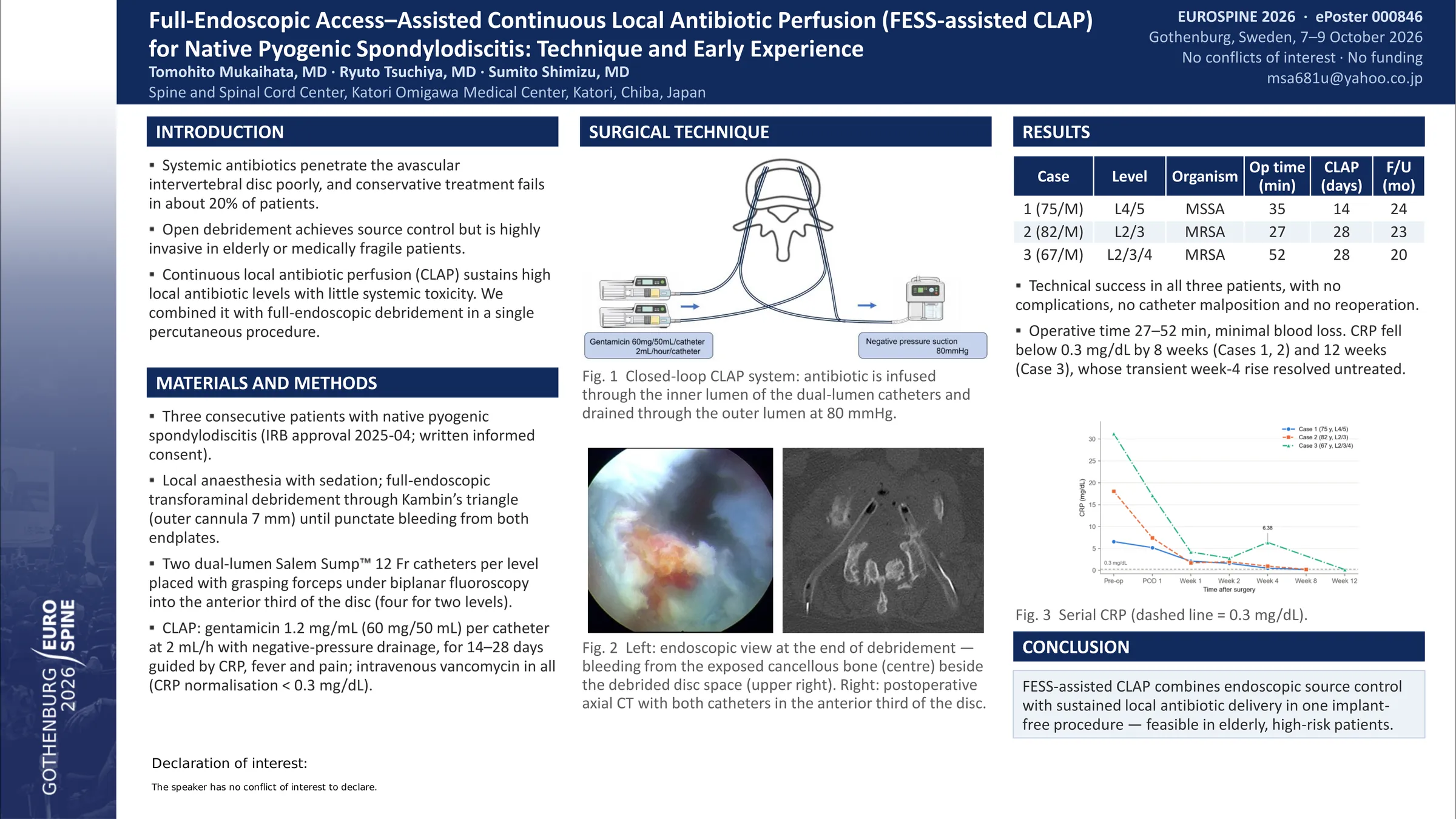
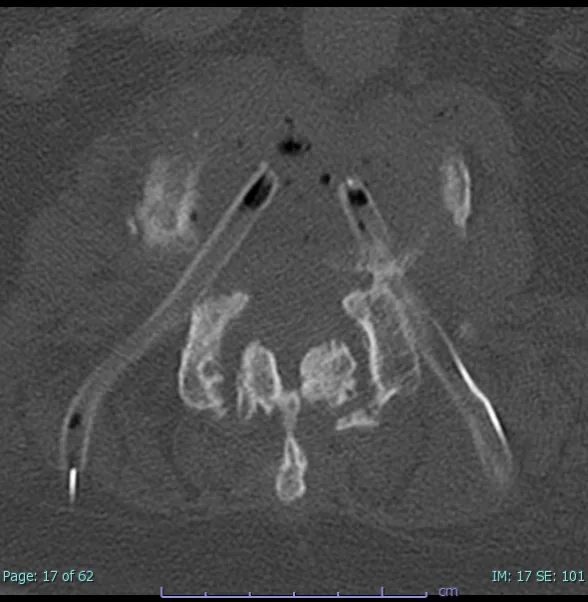
We reviewed 3 consecutive patients treated at a single center. Mean age was 74.7 ± 7.5 years (range 67–82). Affected levels were bilateral L4/5 (n=1), bilateral L2/3 (n=1), and bilateral L2/3/4 (n=1 ). A transforaminal full-endoscopic approach via Kambin’s triangle was used. Procedures were performed under local anesthesia with sedation. Multiple intradiscal specimens were obtained before antibiotic irrigation. Infected disc material and necrotic endplate cartilage were debrided endoscopically. A multifenestrated catheter was placed intradiscally under endoscopic/fluoroscopic confirmation . Closed-loop CLAP was initiated with low-pressure infusion and simultaneous suction. Gentamicin concentration was 60 mg/50 mL per catheter. Infusion rate was 2 mL/hour per catheter . Catheters were placed bilaterally when indicated (two-level bilateral used four catheters). Planned catheter dwell time was 14–28 days with systemic antibiotics concurrently.
Technical success was 100% (3/3). Operative times were 35, 27, and 52 minutes (median 35) . Blood loss was minimal in all cases (endoscopic procedures ). Catheter dwell times were 14, 28, and 28 days (median 28; range 14–28). No intraoperative complications occurred. No early catheter-related adverse events were observed . Reoperation for persistent infection was 0/3. Clinical symptoms improved in all patients during early follow-up.CRP decreased over postoperative weeks 4–12 in all cases. Follow-up durations were 24, 23, and 20 months (median 23; range 224). No o late recurrence requiring repeat surgery was observed during follow-up.
FESS-assisted CLAP is feasible and reproducible for native pyogenic spondylodiscitis. The method combines targeted nidus clearance with sustained high local antibiotic exposure.Early outcomes showed infection control without reoperation and with minimal morbidit y.Larger prospective studies are needed to refine indications and confirm comparative effectiveness.
Figures and tables
As submitted with the abstract. Tap a figure to open it at full size.