
Degenerative Thoracolumbar
Effects of Out-of-Hours Surgery in Cauda Equina Syndrome
- Beaumont Hospital, Dublin, Ireland
Abstract
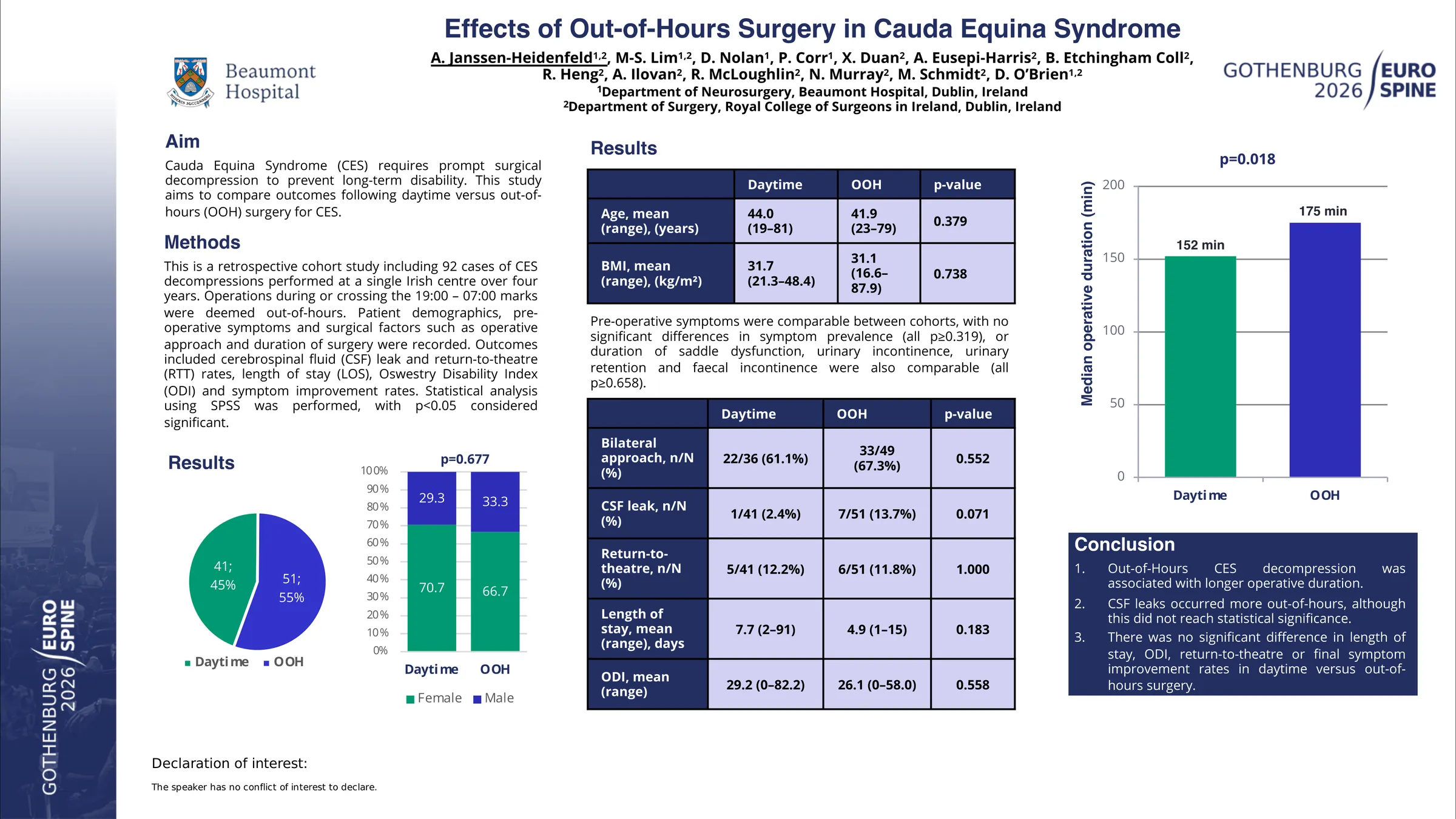
Cauda equina syndrome (CES) requires emergency decompression to prevent long-term disability. This study compares outcomes in daytime versus out-of-hours operating for CES.
This is a retrospective cohort study of 92 CES decompressions at a single Irish centre over 4 years. Patient, disease and operative factors were recorded alongside outcomes including Oswestry Disability Index (ODI), return-to-theatre (RTT), complication and symptom improvement rates. Operations between or crossing 8pm and 7am were deemed out-of-hours. Statistical analysis in Jamovi was performed, using two-sided Mann–Whitney U, Pearson’s chi-square, and Fisher’s exact tests, as appropriate, with p<0.05 considered significant.
Of 92 cases, 41 (44.6%) were performed during the day and 51 (55.4%) were out-of-hours. There was no significant difference in age, sex, Body Mass Index, operator seniority or surgical approach between groups. Night operations took longer (p=0.018), while RTT rates (p=1.000), LOS (p=0.332), ODI (p=0.874), and overall symptom improvement rates were comparable. The only symptom-specific difference was faecal incontinence, which improved more in out-of-hours surgery (13/13 (100%) vs 7/11 (63.6%), p=0.031), noting small subgroup sizes. Although intra-operative complications were uncommon and did not reach significance (p=0.176), they were over three times more prevalent out-of-hours (15.7%, 8/51; vs 4.9%, 2/41).
In this cohort, night operating was associated with longer operative duration, while RTT, LOS and ODI were comparable between groups. Intra-operative complications were uncommon and, although not significant, occurred more out-of-hours. This trend is in keeping with the literature and may support selective nighttime operating, however, further research is required.