
Degenerative Thoracolumbar
Evaluation of Bladder Function and Quality of Life in Surgically Treated Patients with Cauda Equina Syndrome: An Ambispective Study
- PGIMER, Chandigarh, India
Abstract
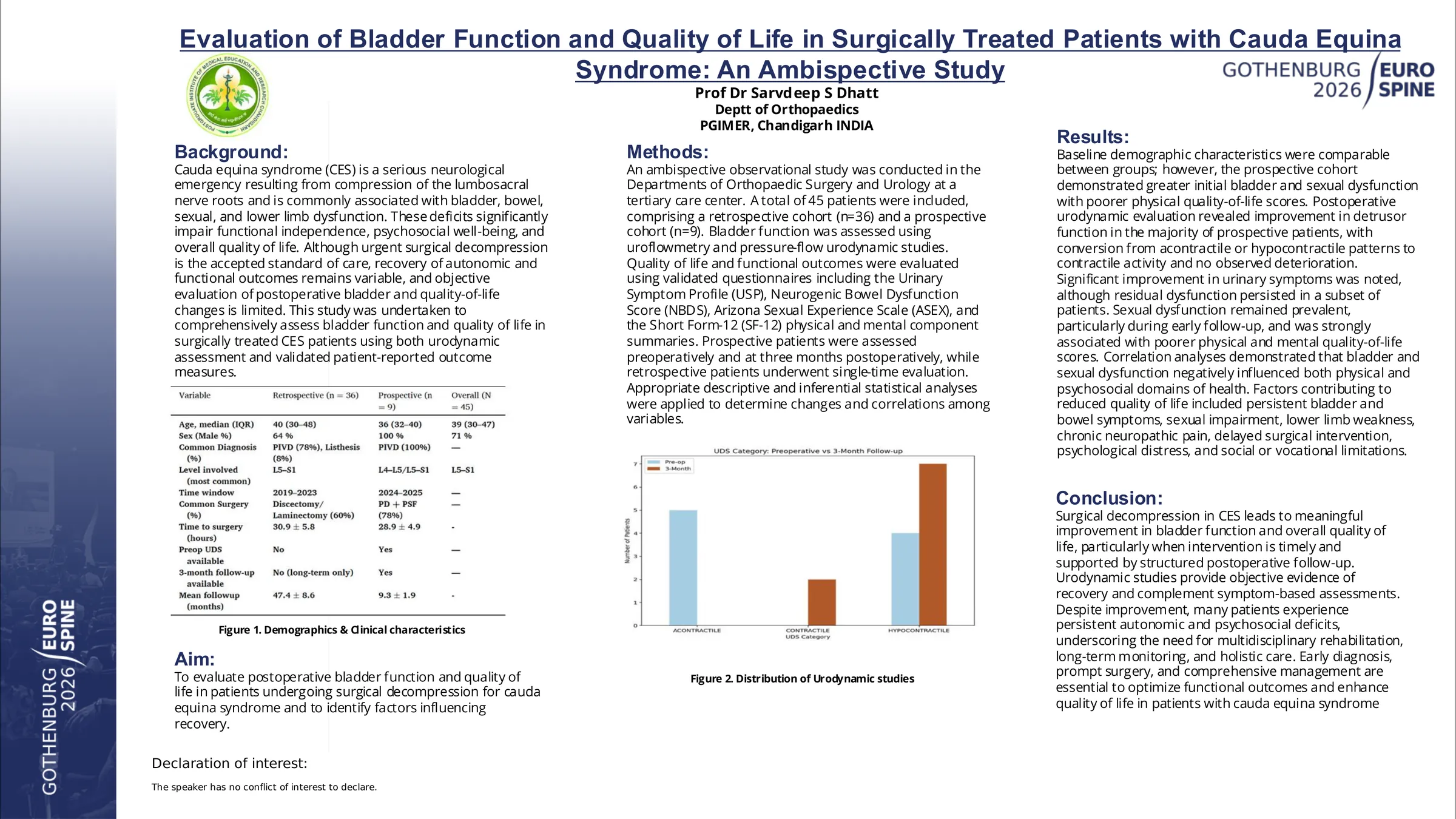
To evaluate postoperative bladder function and quality of life in patients undergoing surgical decompression for cauda equina syndrome and to identify factors influencing recovery. This study was undertaken to comprehensively assess bladder function and quality of life in surgically treated CES patients using both urodynamic assessment and validated patient-reported outcome measures.
An ambispective observational study was conducted in the Departments of Orthopaedic Surgery and Urology at a tertiary care center. A total of 45 patients were included, comprising a retrospective cohort (n=36) and a prospective cohort (n=9). Bladder function was assessed using uroflowmetry and pressure-flow urodynamic studies. Quality of life and functional outcomes were evaluated using validated questionnaires including the Urinary Symptom Profile (USP), Neurogenic Bowel Dysfunction Score (NBDS), Arizona Sexual Experience Scale (ASEX), and the Short Form-12 (SF-12) physical and mental component summaries. Prospective patients were assessed preoperatively and at three months postoperatively, while retrospective patients underwent single-time evaluation.
Baseline demographic characteristics were comparable between groups; however, the prospective cohort demonstrated greater initial bladder and sexual dysfunction with poorer physical quality-of-life scores. Postoperative urodynamic evaluation revealed improvement in detrusor function in the majority of prospective patients, with conversion from acontractile or hypocontractile patterns to contractile activity and no observed deterioration. Significant improvement in urinary symptoms was noted, although residual dysfunction persisted in a subset of patients. Sexual dysfunction remained prevalent, particularly during early follow-up, and was strongly associated with poorer physical and mental quality-of-life scores. Factors contributing to reduced quality of life included persistent bladder and bowel symptoms, sexual impairment, lower limb weakness, chronic neuropathic pain, delayed surgical intervention, psychological distress, and social or vocational limitations.
Surgical decompression in CES leads to meaningful improvement in bladder function and overall quality of life, particularly when intervention is timely and supported by structured postoperative follow-up. Urodynamic studies provide objective evidence of recovery and complement symptom-based assessments. Despite improvement, many patients experience persistent autonomic and psychosocial deficits, underscoring the need for multidisciplinary rehabilitation, long-term monitoring, and holistic care. Early diagnosis, prompt surgery, and comprehensive management are essential to optimize functional outcomes and enhance quality of life in patients with cauda equina syndrome