
Degenerative Thoracolumbar
YouTube Exercise Videos for Lumbar Stenosis and Spondylolisthesis: a Scoping Review of their Quality, Reliability, and Validity
- University Medical Center Groningen, Groningen, Netherlands
- Hanze University Groningen, Groningen, Netherlands
- University Medical Center Groningen, Tilburg, Netherlands
Abstract
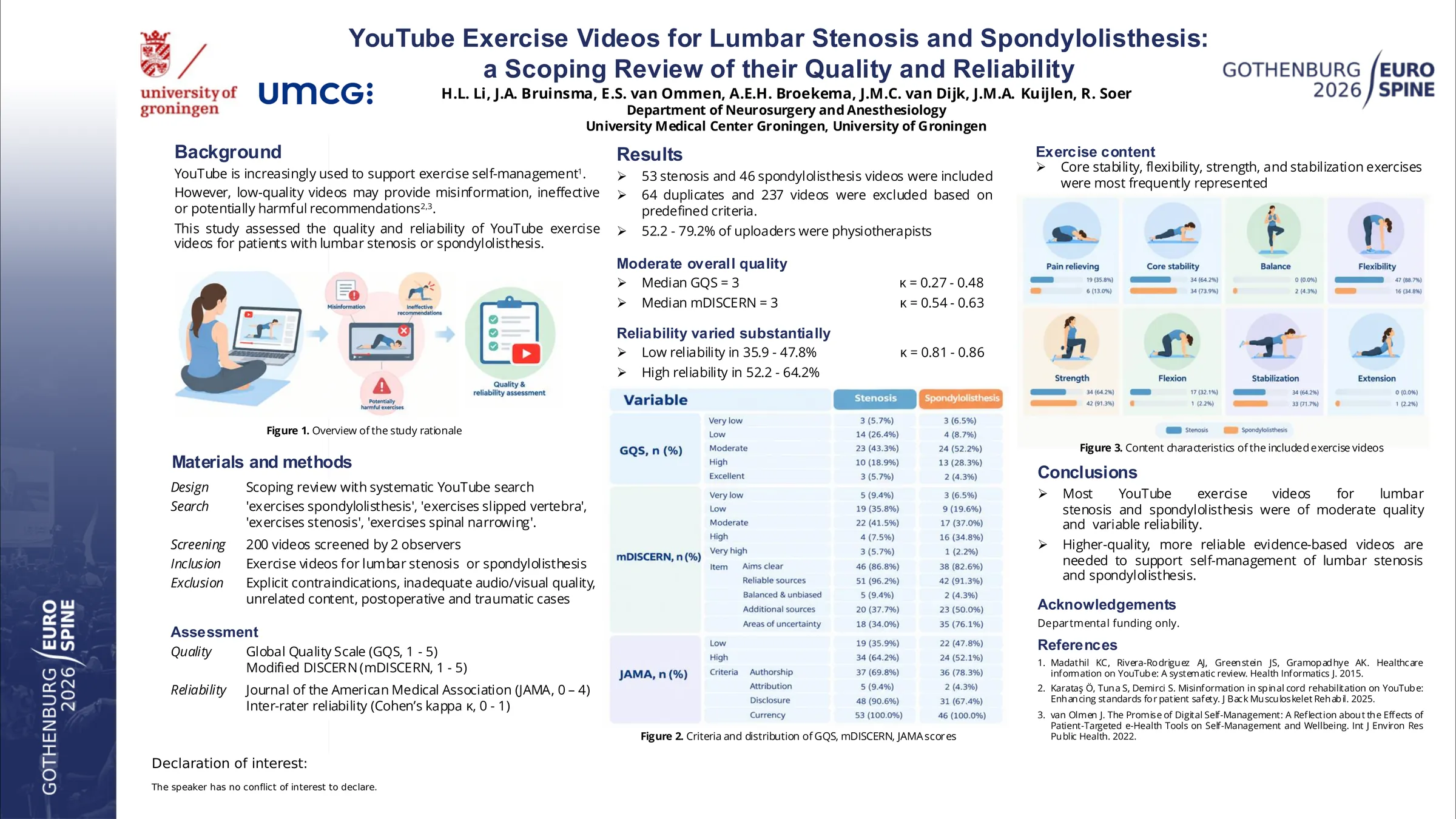
Healthcare providers frequently advise patients diagnosed with lumbar stenosis or spondylolisthesis to improve their physical condition in preparation for surgical intervention. Online platforms, such as YouTube, are increasingly utilized as a self-management resource to access information and to perform exercises. Since low-quality videos might expose patients to misinformation or ineffective, sometimes even harmful exercises, this study aims to provide a comprehensive overview of the current quality, reliability, and validity of YouTube exercise videos for patients with a lumbar stenosis or spondylolisthesis.
A scoping review was conducted using a systematic YouTube search of four Dutch and four English terms. For each search term, the first 50 retrieved videos were reviewed. Exercise videos for lumbar stenosis or spondylolisthesis were included, while videos with explicit contraindications, inadequate audio/visual quality, and unrelated content, including postoperative and traumatic cases, were excluded. Quality was evaluated using the Global Quality Scale (GQS; range 1-5) and modified DISCERN (mDISCERN; range 1-5); Inter-rater reliability was analysed using Cohen’s kappa coefficient (ĸ); Video reliability was assessed with the Journal of the American Medical Association benchmark criteria (JAMA, range 0-4); Validity was determined using the content and disclosed references of each video.
Of 400 retrieved videos, 99 videos were included in the analysis (53 stenosis, 46 spondylolisthesis) after removing duplicates (n=64) and excluding videos based on title (n=203) or predefined criteria (n=34). Physiotherapists were the leading group of uploaders, accounting for 42 (79.2%) videos on stenosis and 24 (52.2%) videos on spondylolisthesis. Quality: The median GQS and mDISCERN score was 3 (moderate quality) for both conditions. Reliability: High content reliability (JAMA ≥3) was observed in 34 (64.2%) videos on stenosis and 24 (52.2%) videos on spondylolisthesis. Inter-rater reliability was low for GQS (ĸ = 0.48 and 0.27, respectively), moderate for mDISCERN (ĸ = 0.63 and 0.54, respectively), and high for JAMA (ĸ = 0.86 and 0.81, respectively). Validity: Validity was limited; only 3 (3.0%) videos cited sources to support the recommended exercises.
The majority of YouTube videos on exercises for lumbar stenosis and spondylolisthesis were of moderate quality, variable reliability, and limited validity. Although many videos aligned with existing literature, notable discrepancies were observed, including the limited representation of certain effective, evidence-based exercises and the inclusion of potentially harmful exercises. Evidence-based videos of higher quality and reliability are needed to support preoperative self-management in patients with lumbar stenosis and/or spondylolisthesis.
Figures and tables
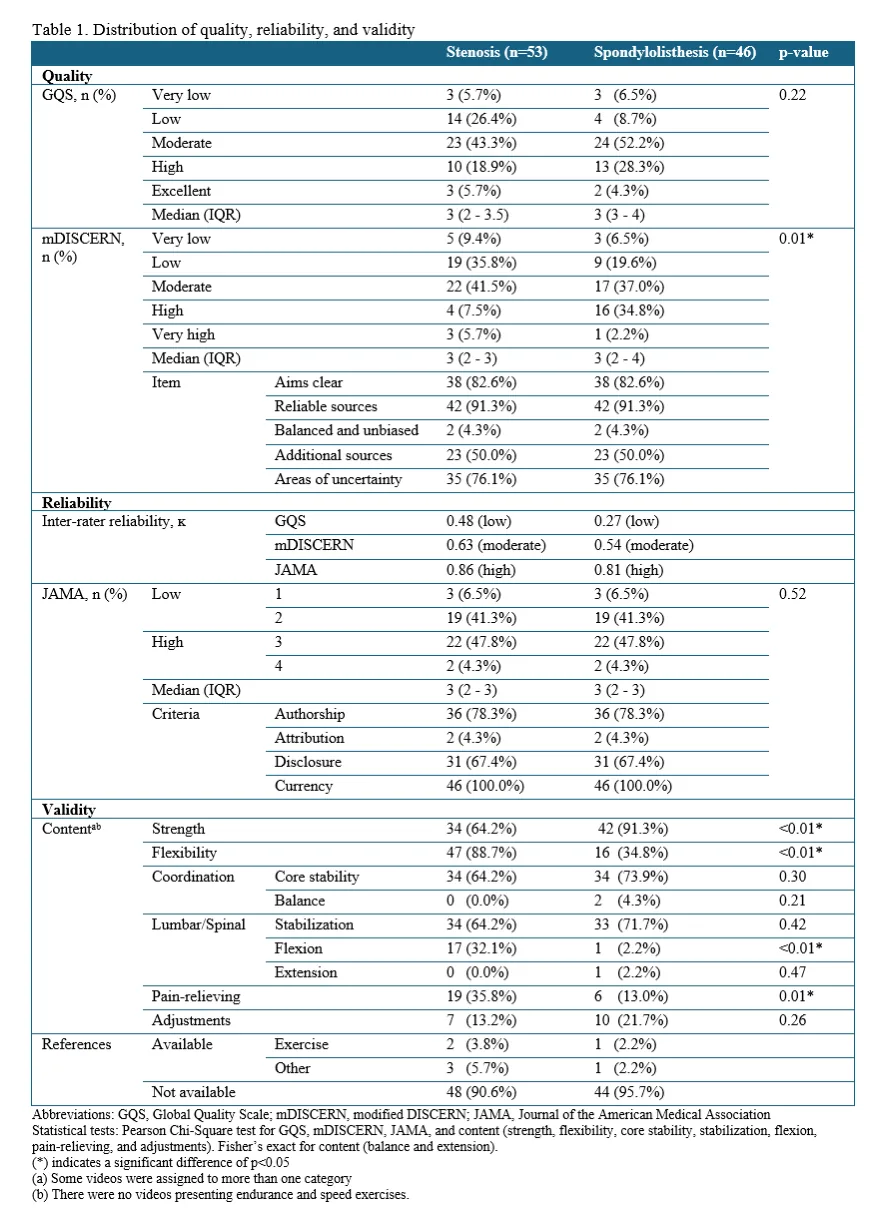
As submitted with the abstract. Tap a figure to open it at full size.