
Degenerative Thoracolumbar
ESCAPE: Evaluation of Spinal Conservation by Endoscopic Procedures to Avoid Fusion
- Hospital Pellegrin Bordeaux, Bordeaux, France
Abstract
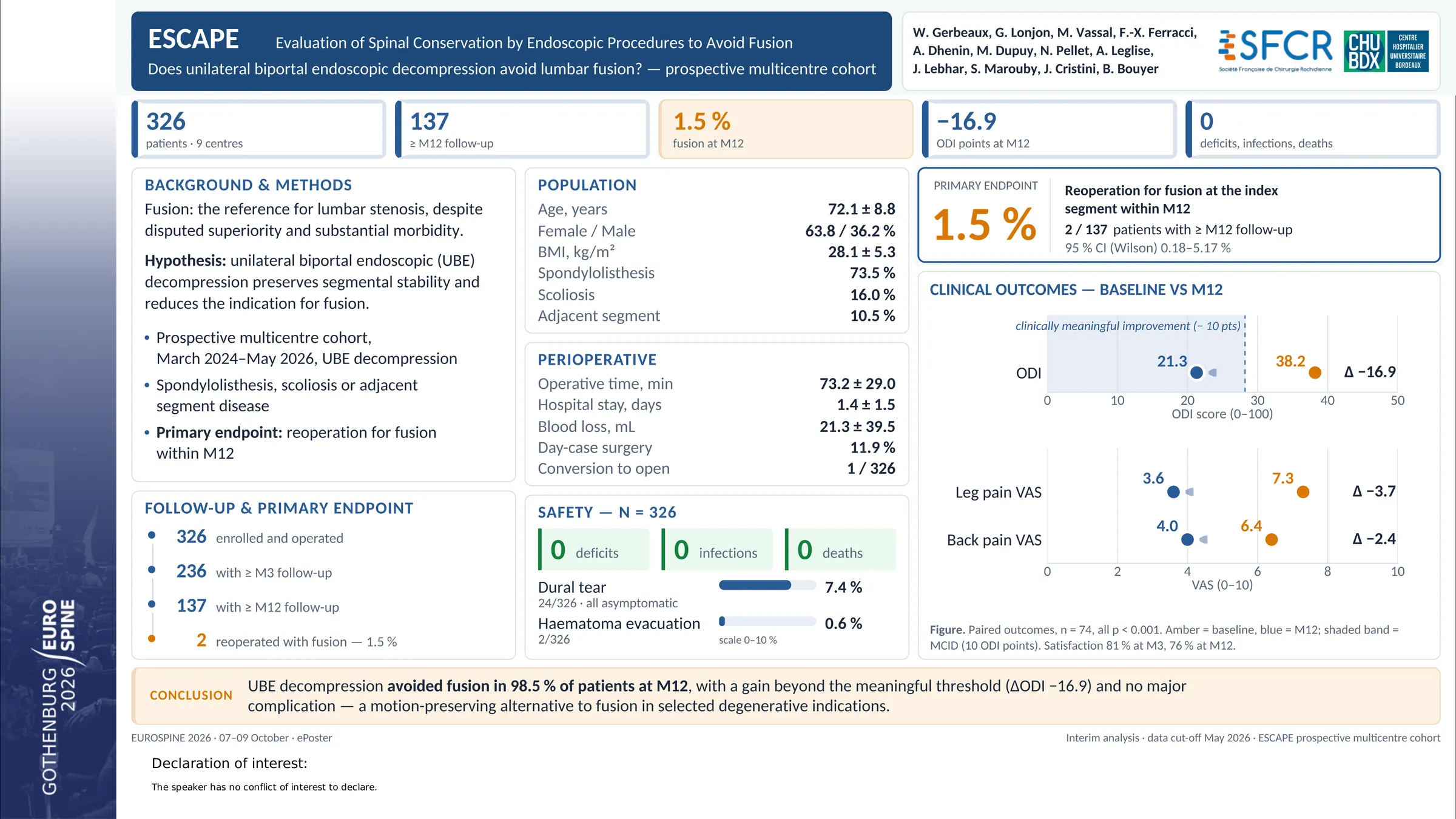
Surgery is frequently considered for degenerative lumbar stenosis when conservative management fails. Endoscopy is a minimally invasive decompression technique aiming to preserve spinal function and stability, potentially reducing the need for fusion. The ESCAPE study evaluates the fusion-sparing potential of endoscopic spinal surgery in this setting.
This multicenter, prospective observational study enrolled 257 patients with severe lumbar stenosis across 8 centers over 30 months. The primary endpoint was the rate of reoperation with fusion at the operated segment within 12 months. Secondary outcomes included patient characteristics, quality of care, and effectiveness at 3, 12, and 24 months, assessed through clinical, radiological, and patient-reported outcomes.
A total of 257 patients (mean age 71.6 years; 38% male) were included. The main indication was stenosis with spondylolisthesis (61%). L4–L5 was the most commonly treated level. Mean operative time and hospital stay were 79 minutes and 1.3 days, respectively. No post-operative infection, no major early complications were reported. At 12 months, 2 patients required reoperation with fusion (2/82 at 12 months, i.e. 2.4%, corresponding to 2/235 patients with ≥3 months of follow-up out of 257 included). ODI and SF-36 scores improved significantly at 3 and 12 months (p < 0.001). Analgesic use decreased from 77% preoperatively to 29% at 12 months. Patient satisfaction was high (80% [69.9-90.1%] at 12 months).
Endoscopic spinal surgery demonstrated a strong fusion-sparing effect in patients with severe lumbar stenosis, with significant clinical and functional improvement. These results support endoscopy as a valuable minimally invasive alternative to lumbar fusion in selected indications.