Degenerative Thoracolumbar
Does oblique lumbar interbody fusion induce lordosis or kyphosis?
- Beijing University, People's Hospital Qingdao Group, Qingdao, China
- Qingdao munipital hospital, Qingdao, China
Abstract
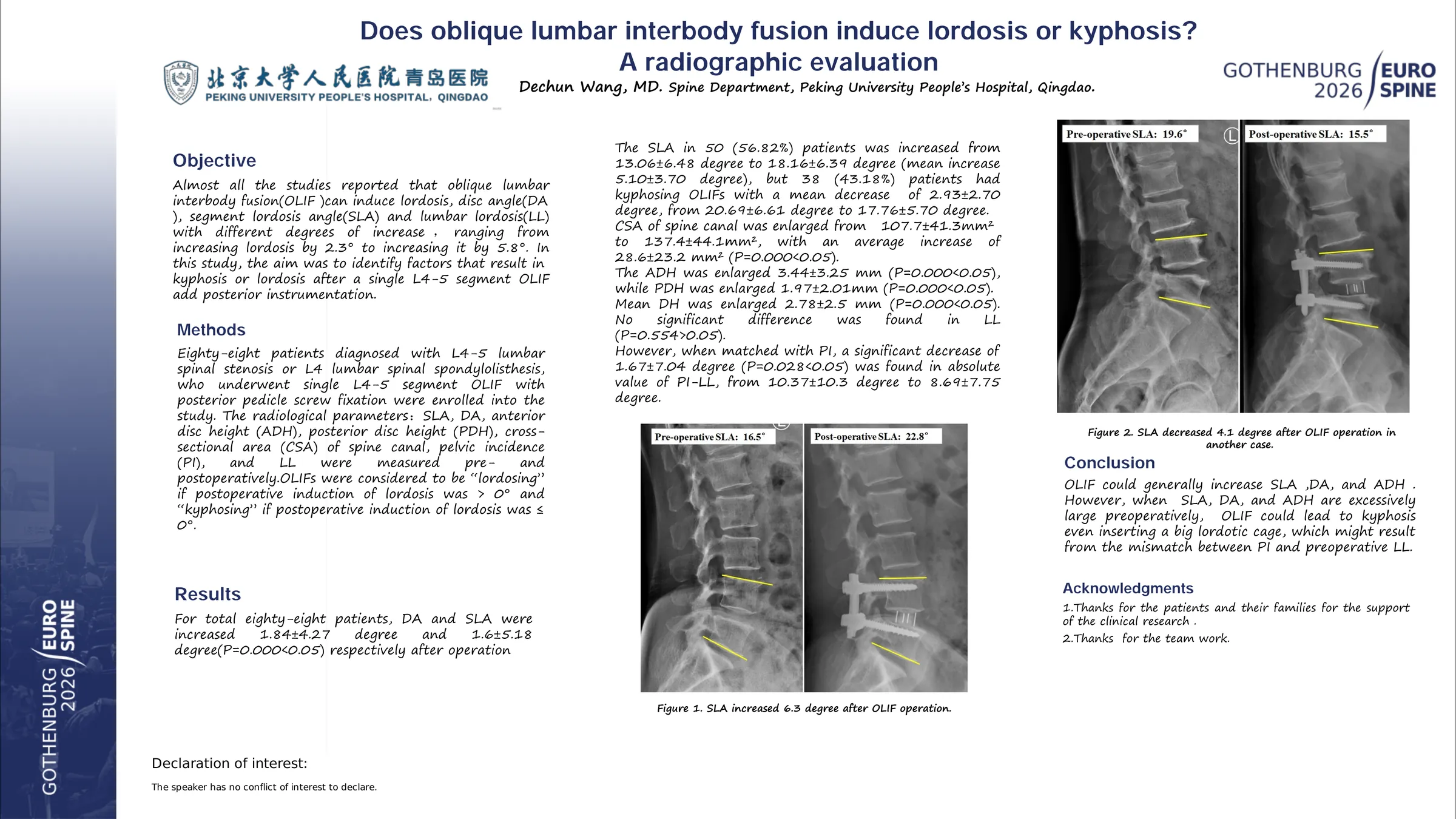
Almost all the studies reported that oblique lumbar interbody fusion(OLIF )can induce lordosis, disc angle(DA ), segment lordosis angle(SLA) and lumbar lordosis(LL) with different degrees of increase,ranging from increasing lordosis by 2.3° to increasing it by 5.8°. In this study, the aim was to identify factors that result in kyphosis or lordosis after a single L4-5 segment OLIF add posterior instrumentation.
Eighty-eight patients diagnosed with L4-5 lumbar spinal stenosis or L4 lumbar spinal spondylolisthesis, who underwent single L4-5 segment OLIF with posterior pedicle screw fixation were enrolled into the study. The radiological parameters:SLA, DA, anterior disc height (ADH), posterior disc height (PDH), cross-sectional area (CSA) of spine canal, pelvic incidence (PI), and LL were measured pre- and postoperatively.OLIFs were considered to be “lordosing” if postoperative induction of lordosis was > 0° and “kyphosing” if postoperative induction of lordosis was ≤ 0°.
For total eighty-eight patients, DA and SLA were increased 1.84±4.27 degree and 1.6±5.18 degree(P=0.000<0.05) respectively after operation. The SLA in 50 (56.82%) patients was increased from 13.06±6.48 degree to 18.16±6.39 degree (mean increase 5.10±3.70 degree), but 38 (43.18%) patients had kyphosing OLIFs with a mean decrease of 2.93±2.70 degree, from 20.69±6.61 degree to 17.76±5.70 degree. CSA of spine canal was enlarged from 107.75±41.36 mm² to 137.41±44.19mm², with an average increase of 28.60±23.27 mm² (P=0.000<0.05). The ADH was enlarged 3.44±3.25 mm (P=0.000<0.05), while PDH was enlarged 1.97±2.01mm (P=0.000<0.05).Mean DH was enlarged 2.78±2.5 mm (P=0.000<0.05). No significant difference was found in LL (P=0.554>0.05). However, when matched with PI, a significant decrease of 1.67±7.04 degree (P=0.028<0.05) was found in absolute value of PI-LL, from 10.37±10.3 degree to 8.69±7.75 degree.
OLIF could generally increase SLA ,DA, and ADH . However, when SLA, DA, and ADH are excessively large preoperatively, OLIF could lead to kyphosis even inserting a big lordotic cage, which might result from the mismatch between PI and preoperative LL.