
Degenerative Thoracolumbar
Description of a novel risk factor for lumbar degenerative spondylolisthesis: descent and verticalization of the spinous process
- Hospital Arnau de Vilanova, Valencia, Spain
- FISABIO Centro de Investigación Príncipe Felipe, Valencia, Spain
Abstract
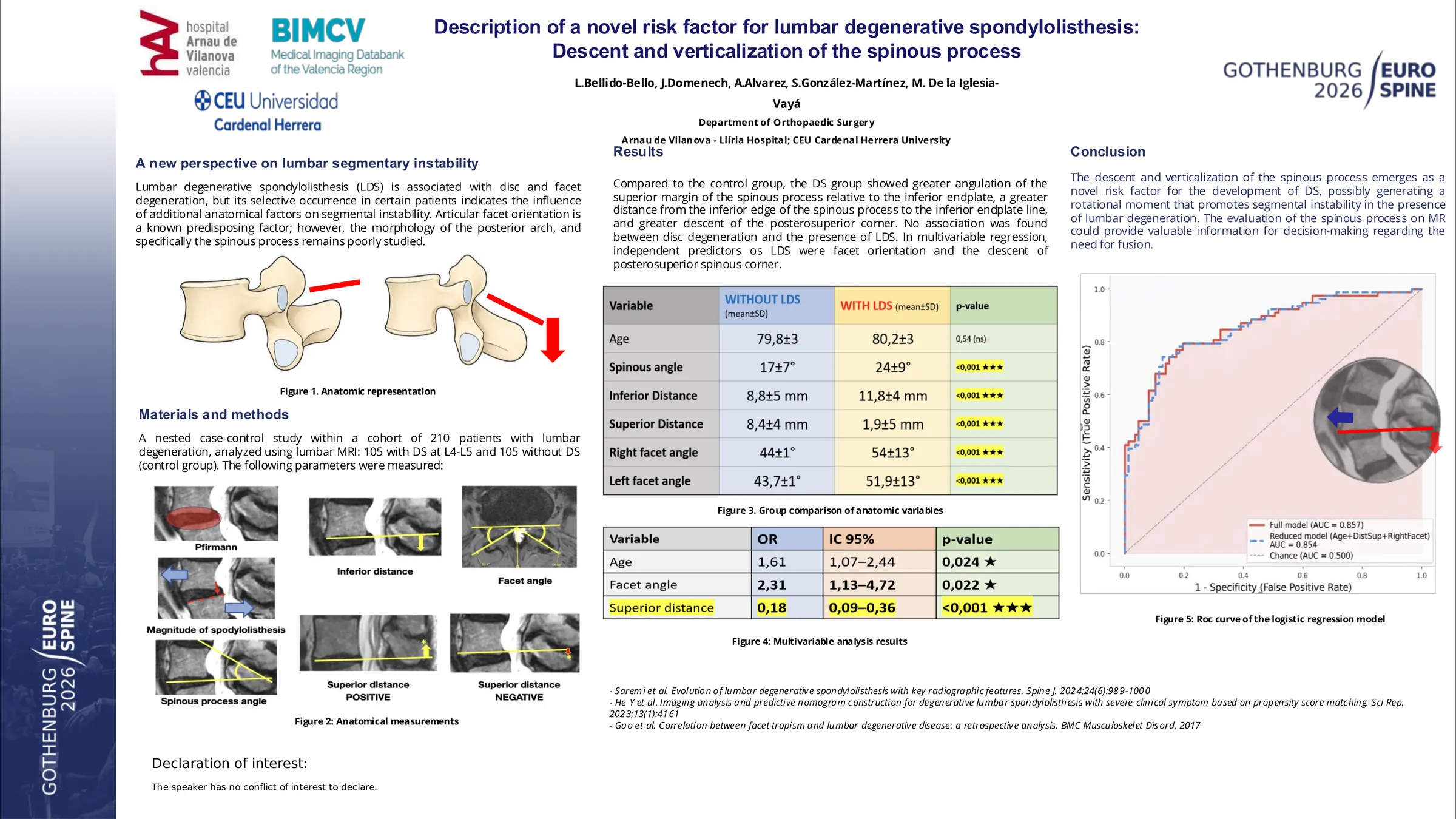
Lumbar degenerative spondylolisthesis (DS) is associated with disc and facet degeneration, but its selective occurrence in certain patients indicates the influence of additional anatomical factors on segmental instability. Articular facet orientation is a known predisposing factor; however, the morphology of the posterior arch, and specifically the spinous process, has been scarcely studied. Our objective is to evaluate the morphology and relative position of the spinous process in patients with lumbar DS compared to patients without DS, adjusting for facet orientation and the degree of disc degeneration.
A nested case-control study within a cohort of 210 patients with lumbar degenerative disk disease, analyzed using lumbar MRI: 105 with DS at L4-L5 and 105 without DS (control group). The following parameters were measured: listhesis magnitude (mm), disc degeneration (Pfirrmann grade), facet orientation, facet tropism, and the position and inclination of the spinous process relative to the inferior vertebral endplate. Comparative, correlational, and multivariable logistic regression analyses were performed.
Compared to the control group, the DS group showed greater angulation of the superior margin of the spinous process relative to the inferior endplate (24°±9° vs. 17°±7°; p <0.001), a greater distance from the inferior edge of the spinous process to the inferior endplate line (11.8±4.6 mm vs. 8.8±4.8 mm; p <0.001), and greater descent of the posterosuperior corner (1.9±5.8 mm vs. 8.4±4.7 mm; p<0.001). Furthermore, DS group presented more sagittally oriented facets (44°±10° vs. 54°±13°; p<0.001). No association was found between the degree of disc degeneration and the presence of DS. The magnitude of listhesis correlated moderately with spinous descent (r = -0.46; p<0.001) and weakly with sagittal facet orientation (r = 0.34; p<0.001). In multivariable regression, independent predictors of DS were facet orientation (OR per 1 SD: 3.04; 95% CI: 1.64–10.61) and the descent of the posterosuperior spinous corner (OR per 1 SD: 0.15; 95% CI: 0.03–0.29).
The descent and verticalization of the spinous process emerges as a novel risk factor for the development of DS, possibly generating a rotational moment that promotes segmental instability in the presence of lumbar degeneration. The evaluation of the spinous process on MR could provide valuable information for decision-making regarding the need for fusion.