
Cervical & Neural Pathologies
Comparison Between Right- and Left-Sided Anterolateral Approaches in Anterior Cervical Fusion: A Four-Year prospective comparative analysis
- Humanitas San Pio X, Milano, Italy
- Humanitas San Pio X, Rome, Italy
Abstract
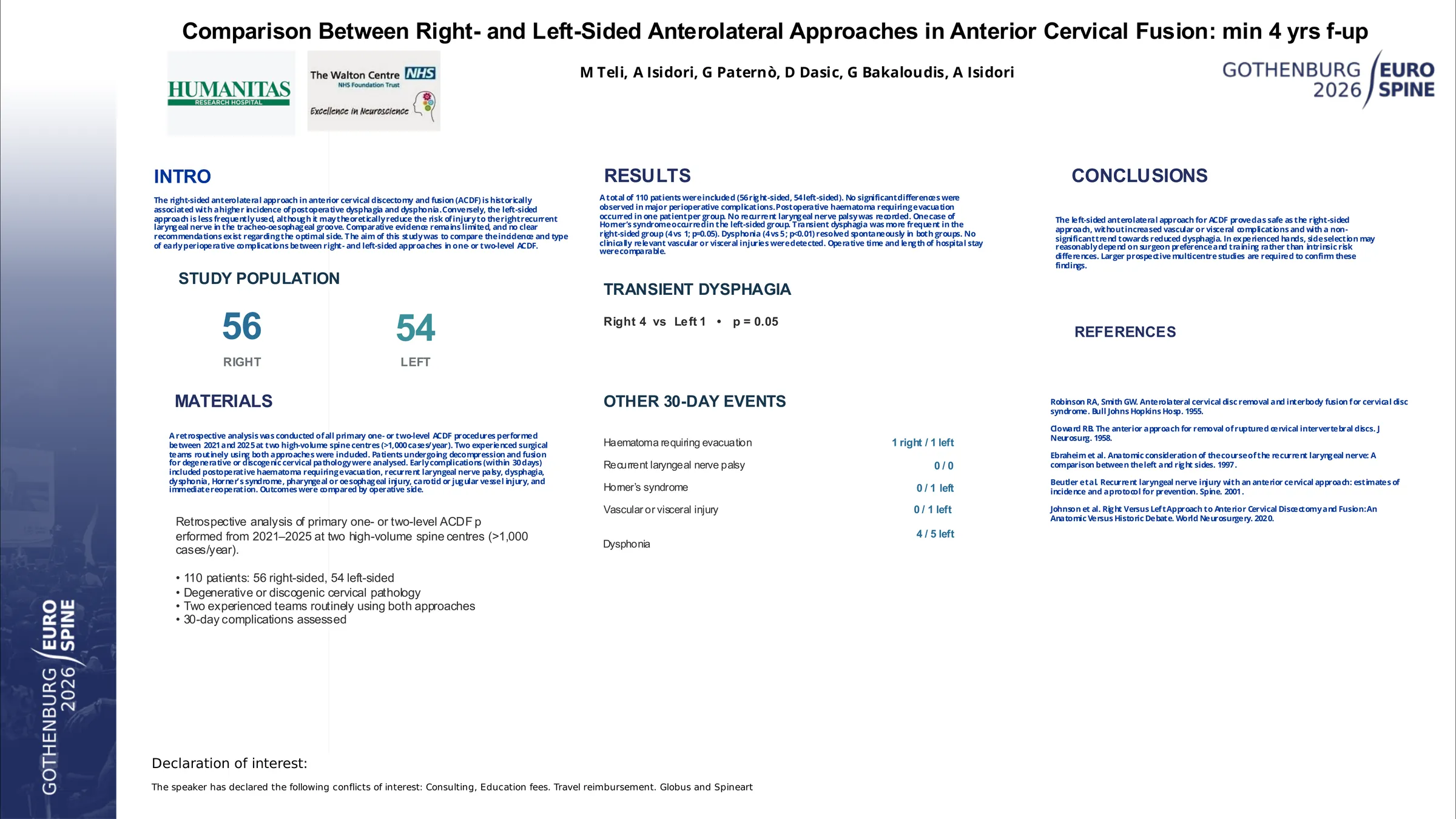
The right-sided anterolateral approach in anterior cervical discectomy and fusion (ACDF) is historically associated with a higher incidence of postoperative dysphagia and dysphonia. Conversely, the left-sided approach is less frequently used, although it may theoretically reduce the risk of injury to the right recurrent laryngeal nerve in the tracheo-oesophageal groove. Comparative evidence remains limited, and no clear recommendations exist regarding the optimal side. The aim of this study was to compare the incidence and type of early perioperative complications between right- and left-sided approaches in one- or two-level ACDF.
A prospective analysis was conducted of all primary one- or two-level ACDF procedures performed between 2021 and 2025 at two high-volume spine centres (>1,000 cases/year). Two experienced surgical teams routinely using both approaches were included. Patients undergoing decompression and fusion for degenerative or discogenic cervical pathology were analysed. Early complications (within 30 days) included postoperative haematoma requiring evacuation, recurrent laryngeal nerve palsy, dysphagia, dysphonia, Horner’s syndrome, pharyngeal or oesophageal injury, carotid or jugular vessel injury, and immediate reoperation. Outcomes were compared by operative side.
A total of 110 patients were included (56 right-sided, 54 left-sided). No significant differences were observed in major perioperative complications. Postoperative haematoma requiring evacuation occurred in one patient per group. No recurrent laryngeal nerve palsy was recorded. One case of Horner’s syndrome occurred in the left-sided group. Transient dysphagia was more frequent in the right-sided group (4 vs 1; p=0.05). Dysphonia (4 vs 5; p<0.01) resolved spontaneously in both groups. No clinically relevant vascular or visceral injuries were detected. Operative time and length of hospital stay were comparable.
The left-sided anterolateral approach for ACDF proved as safe as the right-sided approach, without increased vascular or visceral complications and with a non-significant trend towards reduced dysphagia. In experienced hands, side selection may reasonably depend on surgeon preference and training rather than intrinsic risk differences.