Growing Spine
Intraoperative CT-Assisted Navigation Reduces Radiation Exposure in Adolescent Spinal Deformity: A Comparative Study of 182 Consecutive Patients
- Humanitas San Pio X, Rome, Italy
- Humanitas San Pio X, Milano, Italy
Abstract
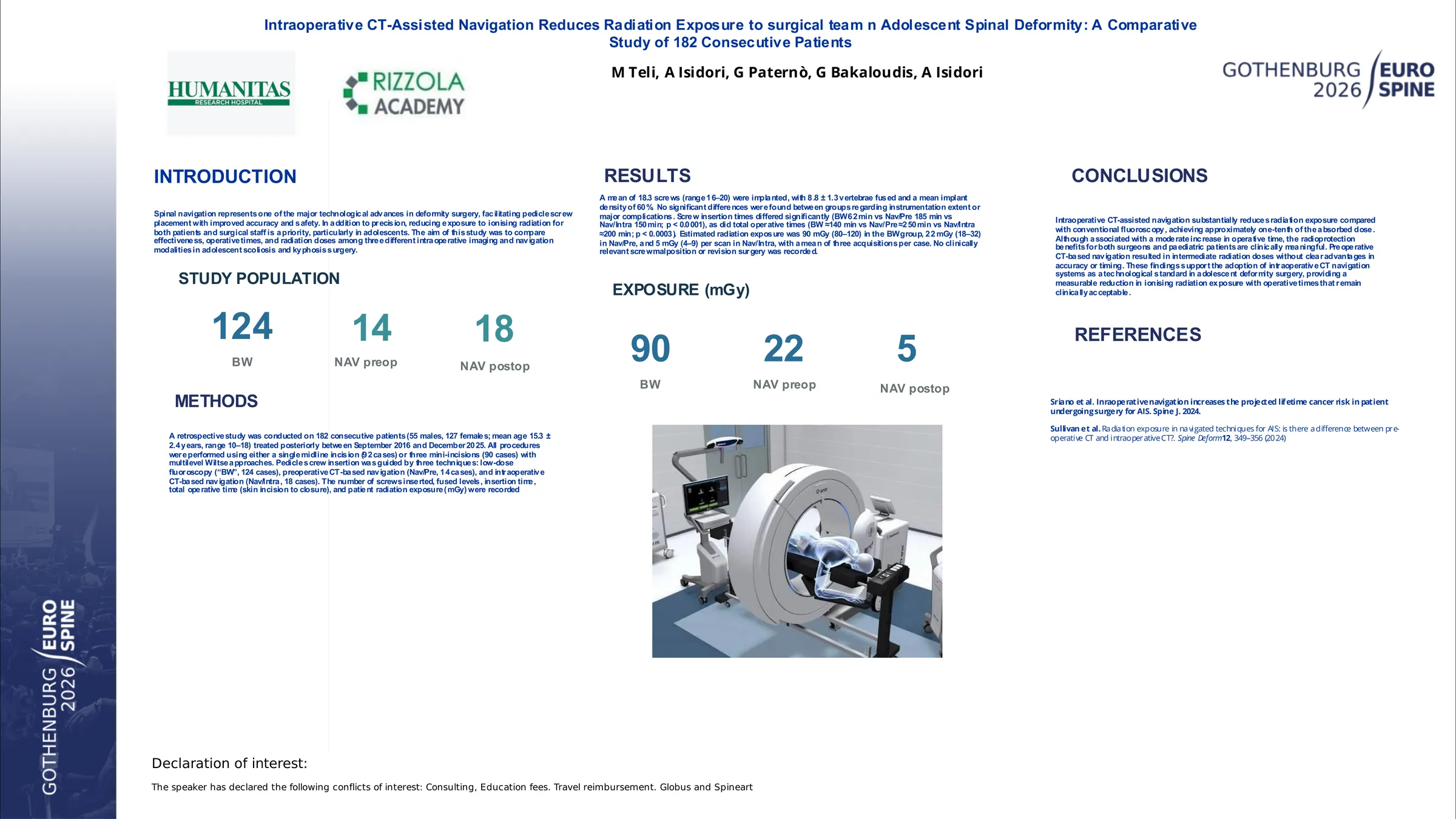
Spinal navigation represents one of the major technological advances in deformity surgery, facilitating pedicle screw placement with improved accuracy and safety. In addition to precision, reducing exposure to ionising radiation for both patients and surgical staff is a priority, particularly in adolescents. The aim of this study was to compare effectiveness, operative times, and radiation doses among three different intraoperative imaging and navigation modalities in adolescent scoliosis and kyphosis surgery.
A retrospective study was conducted on 182 consecutive patients (55 males, 127 females; mean age 15.3 ± 2.4 years, range 10–18) treated posteriorly between September 2016 and December 2025. All procedures were performed using either a single midline incision (92 cases) or three mini-incisions (90 cases) with multilevel Wiltse approaches. Pedicle screw insertion was guided by three techniques: low-dose fluoroscopy (“BW”, 124 cases), preoperative CT-based navigation (Nav/Pre, 14 cases), and intraoperative CT-based navigation (Nav/Intra, 18 cases). The number of screws inserted, fused levels, insertion time, total operative time (skin incision to closure), and patient radiation exposure (mGy) were recorded.
A mean of 18.3 screws (range 16–20) were implanted, with 8.8 ± 1.3 vertebrae fused and a mean implant density of 60%. No significant differences were found between groups regarding instrumentation extent or major complications. Screw insertion times differed significantly (BW 62 min vs Nav/Pre 185 min vs Nav/Intra 150 min; p < 0.0001), as did total operative times (BW ≈140 min vs Nav/Pre ≈250 min vs Nav/Intra ≈200 min; p < 0.0003). Estimated radiation exposure was 90 mGy (80–120) in the BW group, 22 mGy (18–32) in Nav/Pre, and 5 mGy (4–9) per scan in Nav/Intra, with a mean of three acquisitions per case. No clinically relevant screw malposition or revision surgery was recorded.
Intraoperative CT-assisted navigation substantially reduces radiation exposure compared with conventional fluoroscopy, achieving approximately one-tenth of the absorbed dose. Although associated with a moderate increase in operative time, the radioprotection benefits for both surgeons and paediatric patients are clinically meaningful. Preoperative CT-based navigation resulted in intermediate radiation doses without clear advantages in accuracy or timing. These findings support the adoption of intraoperative CT navigation systems as a technological standard in adolescent deformity surgery, providing a measurable reduction in ionising radiation exposure with operative times that remain clinically acceptable.