
Basic Science & Economics
Chondrocyte senescence in facet joint cartilage of adolescent idiopathic scoliosis and the therapeutic potential of senolytic drugs
- McGill University, Montréal, Canada
- Bio-Medico Campus University Hospital, Rome, Italy
Abstract
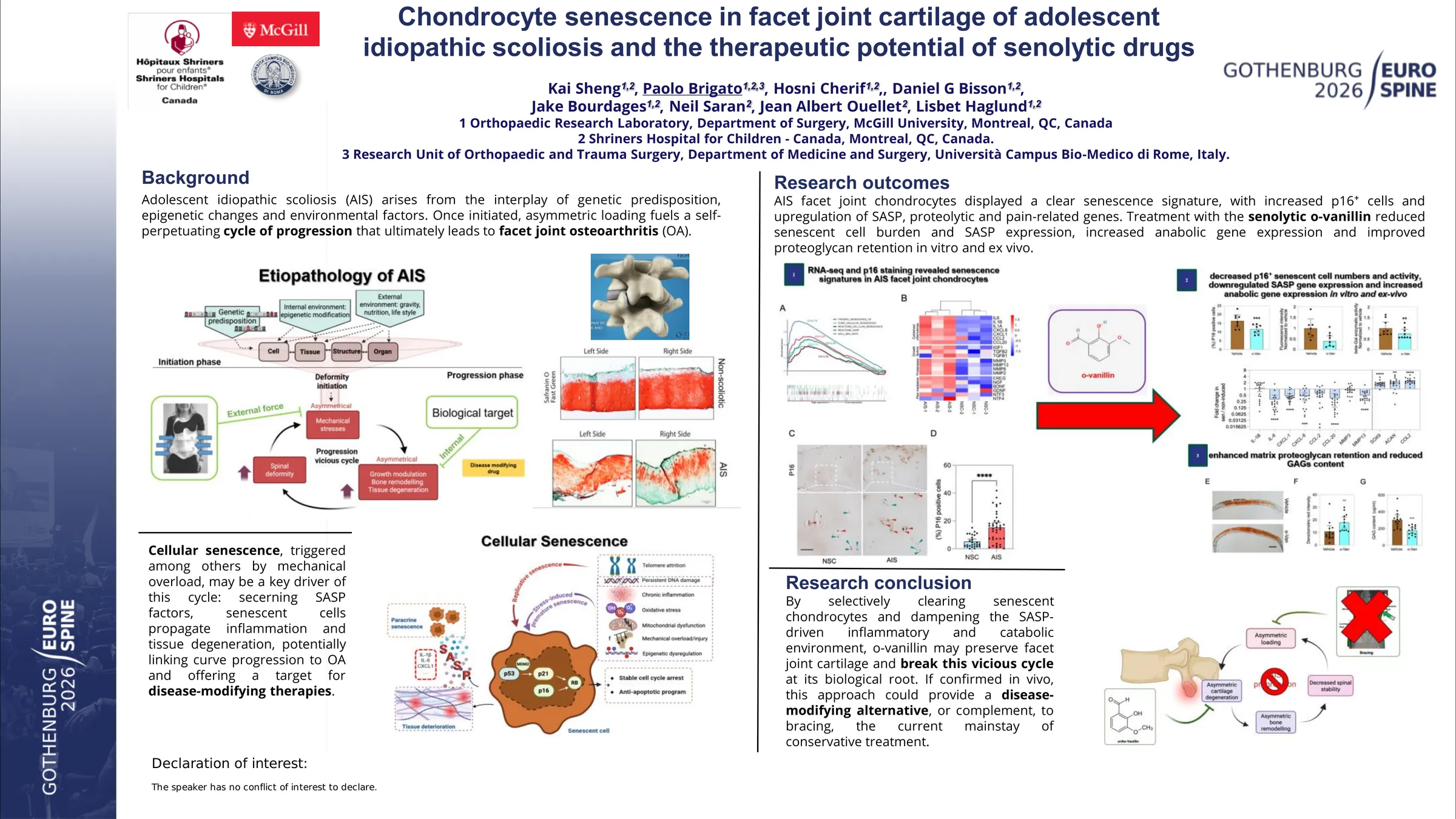
Facet joint osteoarthritis (OA) is increasingly recognized in adolescent idiopathic scoliosis (AIS) and may contribute to curve progression through impaired control of axial rotation. While cellular senescence is a key driver of age-related OA, its role in adolescent OA and the therapeutic potential of senolytics remain unexplored. This study aimed to characterize cellular senescence in AIS-associated facet joint OA and to evaluate the senolytic potential of o-vanillin.
Facet joint cartilage was obtained from 72 AIS patients undergoing elective posterior spinal fusion and 18 non-scoliotic organ donors during multiorgan procurement procedures. Cellular senescence was assessed using RNA sequencing and p16INK4a immunostaining. Paired facet joints from the same spinal level were analyzed to examine side-to-side differences in degeneration and senescence burden by quantifying senescence-associated gene expression using qPCR. The effects of the senolytic compound o-vanillin were evaluated in patient-derived chondrocyte cell cultures and cartilage explant cultures by assessing senescence markers, SASP expression, matrix catabolism, and proteoglycan content.
RNA-seq revealed significant enrichment of senescence-associated gene sets in AIS chondrocytes, with the SEN_MAYO signature exhibiting the strongest enrichment score (ES = 0.76). Consistently, AIS cartilage exhibited a higher proportion of p16-positive chondrocytes compared with non-scoliotic control cells(AIS: 15.28%, 95% CI 11.75–18.81; NSC: 5.22%, 95% CI 3.47–6.96; p < 0.0001). In paired facet joints, increased OA severity was associated with elevated expression of cell-cycle inhibitors, RB family members, and SASP factors, including P16, P21, RB1, RBL1, RBL2, ILs, CXCLs, CCLs and MMPs. O-vanillin treatment reduced senescence markers and SASP expression in in vitro chondrocyte culture, and further attenuated matrix catabolism and improved proteoglycan preservation in ex vivo cartilage explant culture.
Cellular senescence is a prominent feature of AIS-associated facet joint OA and correlates with OA severity. These findings provide a rationale for further investigation of senolytic strategies as potential disease-modifying approaches in AIS.