
Growing Spine
Can machine learning optimize fusion selection in thoracic adolescent idiopathic scoliosis? – a dual-center cohort study with external validation
- Rigshospitalet, Copenhagen East, Denmark
- The University of Hong Kong (HKU), Hong Kong, China
- Rigshospitalet, Copenhagen, Denmark
Abstract
The optimal selection of the lowest instrumented vertebra (LIV) remains a critical challenge in the surgical management of thoracic adolescent idiopathic scoliosis (AIS). Traditional strategies rely on the last touched vertebra (LTV), but this approach may not fully account for three-dimensional curve- and flexibility characteristics. We aimed to evaluate whether the use of a machine learning algorithm could improve patient-specific fusion selection and decrease the risk of distal adding-on in patients with thoracic AIS.
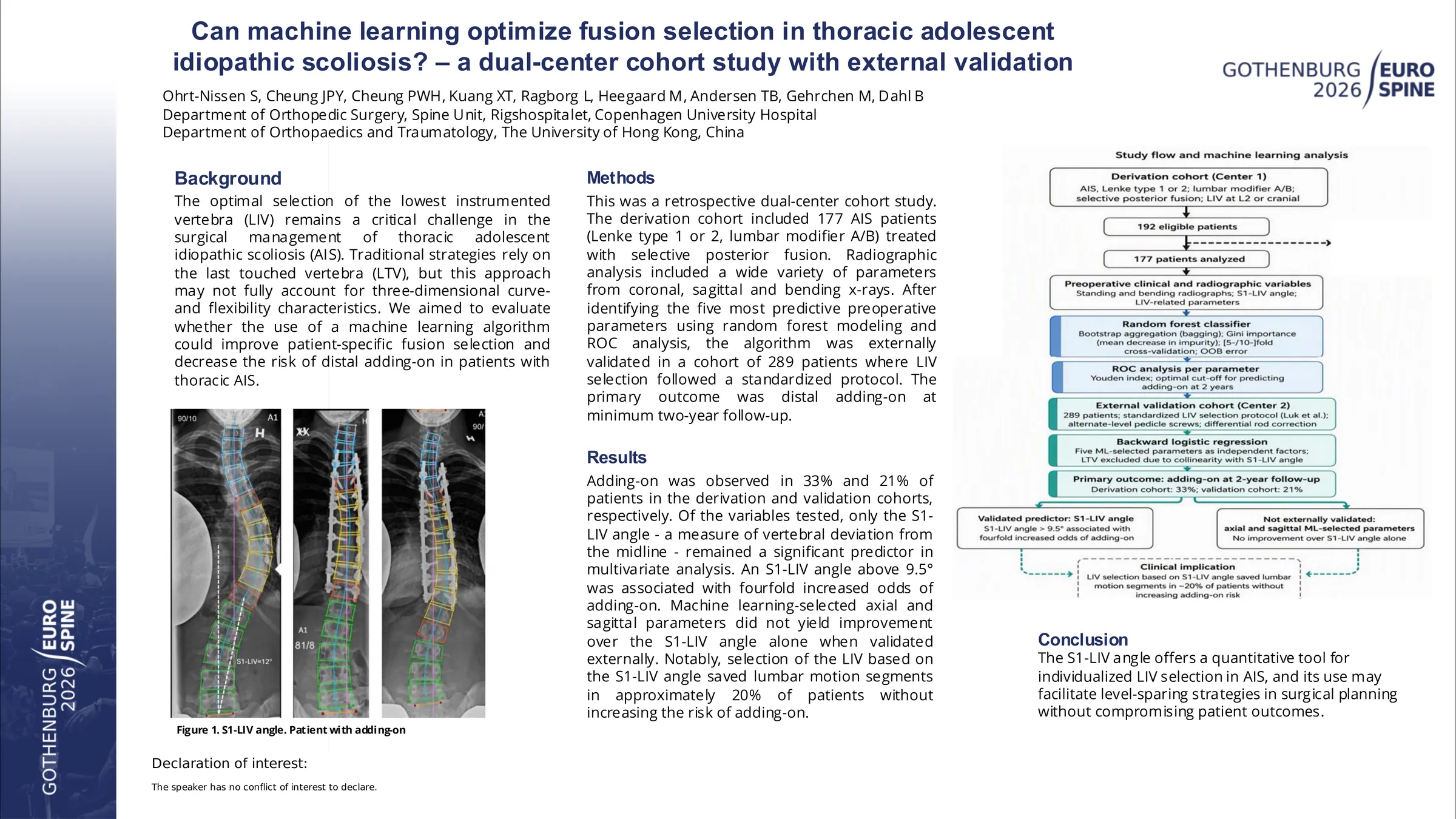
This was a retrospective dual-center cohort study. The derivation cohort included 177 AIS patients (Lenke type 1 or 2, lumbar modifier A/B) treated with selective posterior fusion. Radiographic analysis included a wide variety of parameters from coronal, sagittal and bending x-rays. After identifying the five most predictive preoperative parameters using random forest modeling and ROC analysis, the algorithm was externally validated in a cohort of 289 patients where LIV selection followed a standardized protocol. The primary outcome was distal adding-on at minimum two-year follow-up.
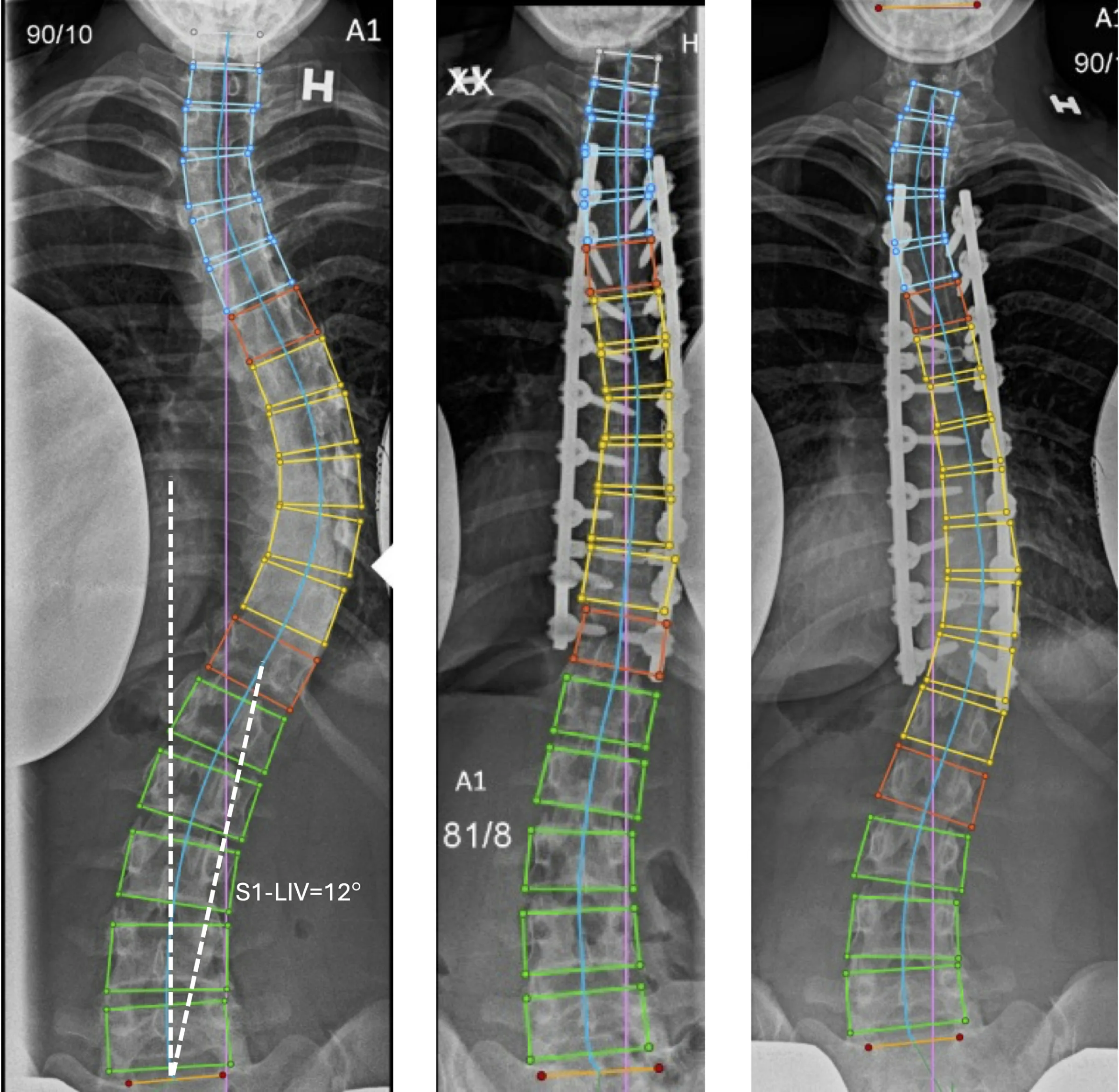
Adding-on was observed in 33% and 21% of patients in the derivation and validation cohorts, respectively. Of the variables tested, only the S1-LIV angle - a measure of vertebral deviation from the midline - remained a significant predictor in multivariate analysis. An S1-LIV angle above 9.5° was associated with fourfold increased odds of adding-on. Machine learning-selected axial and sagittal parameters did not yield improvement over the S1-LIV angle alone when validated externally. Notably, selection of the LIV based on the S1-LIV angle saved lumbar motion segments in approximately 20% of patients without increasing the risk of adding-on.
The S1-LIV angle offers a quantitative tool for individualized LIV selection in AIS, and its use may facilitate level-sparing strategies in surgical planning without compromising patient outcomes.
Figures and tables
As submitted with the abstract. Tap a figure to open it at full size.