Adult Deformity
Types of Pelvic Fixation and Their Influence on Pelvic Incidence Change After Surgery for Adult Spinal Deformity: A Retrospective Analysis
- Brown University, Providence, United States of America
- Hospital Paris Saint-Joseph, Paris, France
- ELSAN Polyclinique Jean Villar, Clinique du Dos, Bordeaux-Terrefort, Pessac, France
- Chu De Bordeaux - Haut-Lévêque, Bordeaux, France
- USC Village, Los Angeles, United States of America
- Duke University, Durham, United States of America
- Brown University, Providen, United States of America
- Centre Medico-Chirurgical Readaptation Massues Croix-Rouge Francaise, Lyon, France
- Hôtel-Dieu de France, Beirut, Lebanon
Abstract
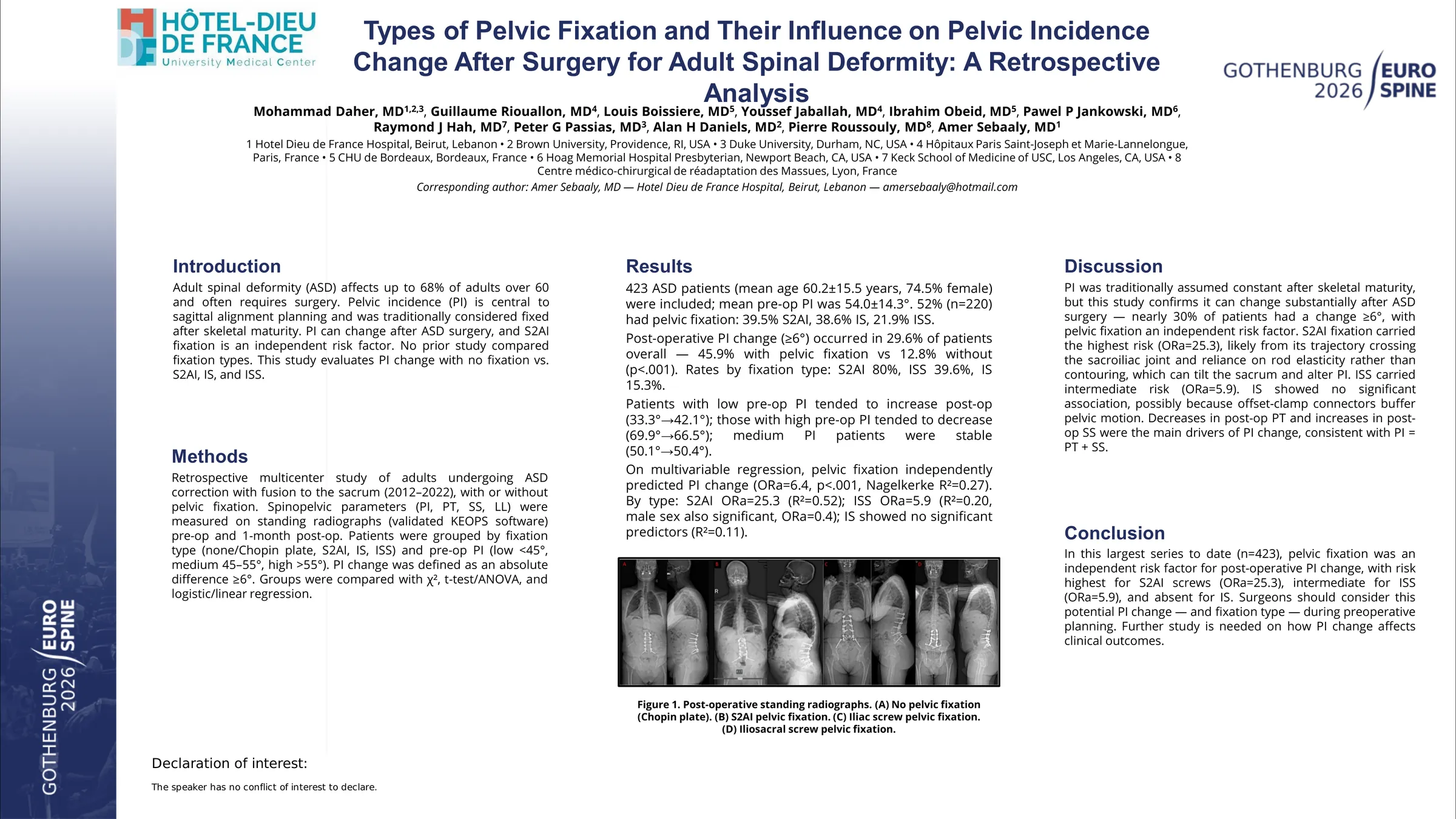
In adult spinal deformity (ASD), restoring sagittal spinal alignment which is usually based on PI is essential to improve the patient’s quality of life. While PI was postulated to be a constant value, recent literature reported that the latter can change with pelvic fixation after ASD surgery. This study will compare post-operative pelvic incidence (PI) modification by types of pelvic-fixation.
This is a retrospective multicenter study of 423 patients who have undergone ASD surgery between 2012 and 2022. These patients were divided into four groups, based on the type of pelvic fixation they received being either S2-Alar-Iliac screws (S2AI), Iliac screws (IS), Iliosacral screws (ISS), and no pelvic-fixation. Post-operative PI change was defined by an absolute difference of ≥ 6° between pre- and post-operative values.
Patients with S2AI had the higher rate of post-operative PI change (80%) followed by patients with ISS (39.6%) and patients with IS (15.3%).). In addition, patients with a low pre-operative PI had an increased post-operative PI (33.3° pre-operatively to 42.1° post-operatively) while patients with a high pre-operative PI had a lower post-operative PI (69.9° pre-operatively to 66.5° post-operatively). A logistic-regression model controlling for gender, pre-operative PI groups, the change in lumbar lordosis, pelvic tilt, sacral slope, and pelvic fixation showed that only the latter predicted the post-operative change in PI with an adjusted odd-ratio of 6.4. However, pelvic fixation was not a predictor of PI modification when we selected only patients with IS.
Pelvic fixation was found to be an independent risk factor for PI change with an adjusted Odds-ratio of 6.4. When stratifying by pelvic fixation type, S2AI screws had the greatest impact on post-operative PI change (Odds-ratio=25.3) followed by ISS (Odds-ratio=5.9) with IS having no impact on post-operative PI change.