
Adult Deformity
Can lumbar lordosis distribution be designed? A simple intraoperative formula using the P-shift concept
- Kyoto University Hospital, Kyoto, Japan
- Kyoto City Hospital, Kyoto, Japan
Abstract
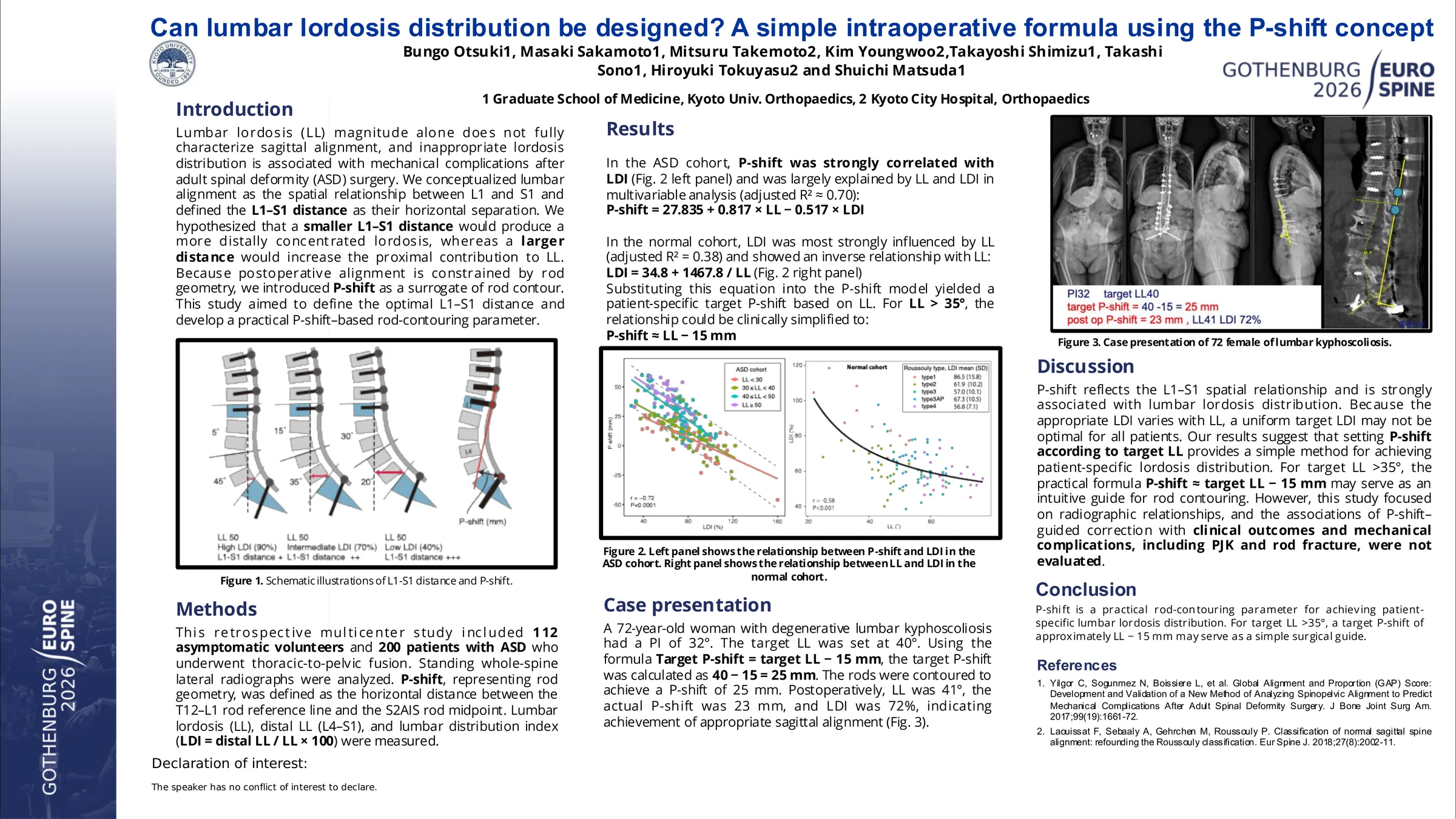
Lumbar curvature is determined not only by lumbar lordosis (LL) but also by its segmental distribution within the lumbar spine. Although surgeons can create a target LL intraoperatively, controlling its distribution remains difficult. We hypothesized that the horizontal offset between the distal thoracic spine and the sacrum determines lordosis distribution and can serve as a practical intraoperative indicator for rod contouring. The purpose of this study was to investigate the relationship between this horizontal parameter and lordosis distribution and to establish a simple intraoperative target for rod configuration in adult spinal deformity (ASD) surgery.
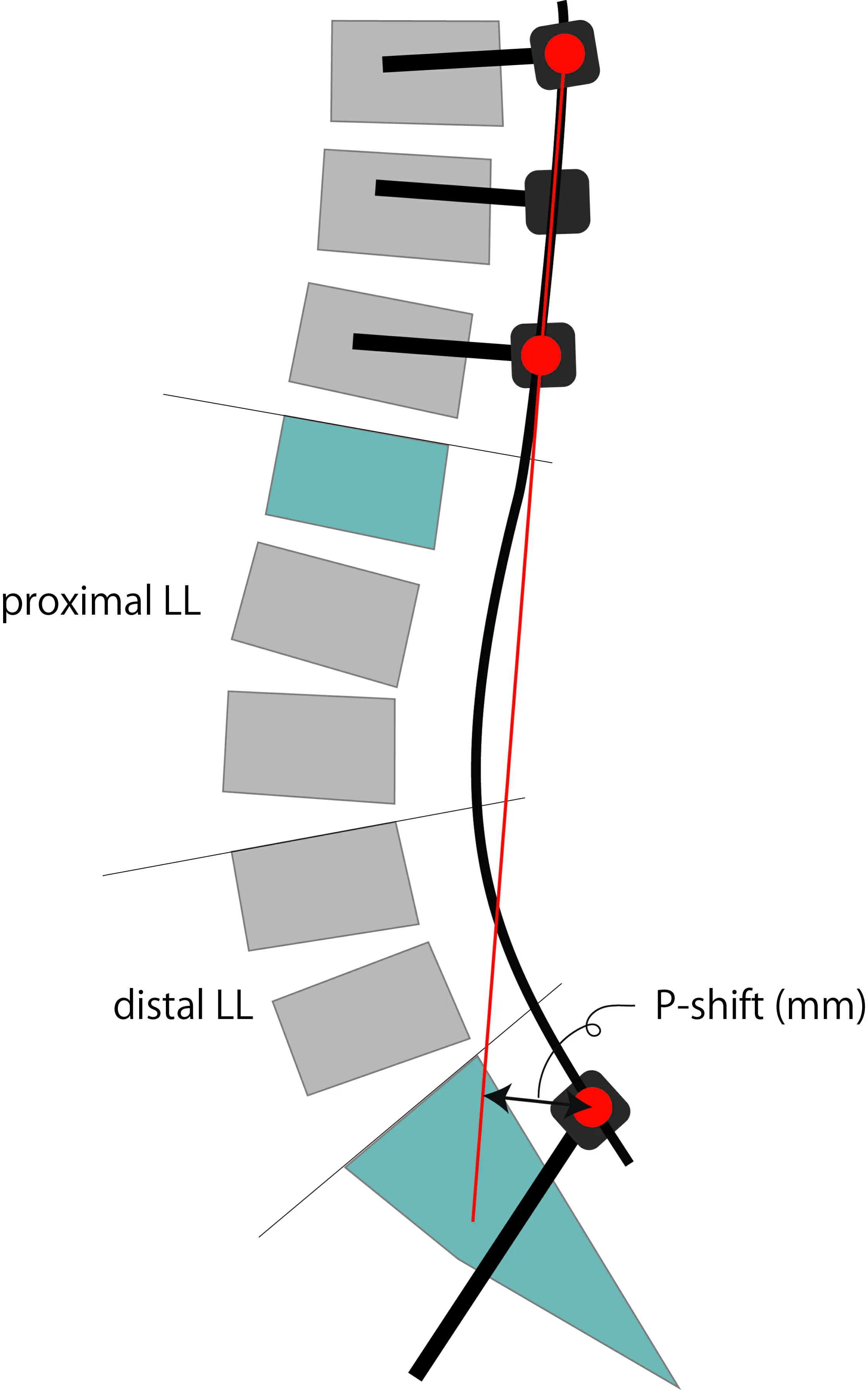
We evaluated 112 asymptomatic volunteers (mean age 36 years, 80 females) and 80 ASD patients (mean age 71 years, 63 females) who underwent thoracic-to-pelvic fixation. As an indicator of the horizontal offset between the distal thoracic spine and the sacrum, P-shift (mm) was defined as the horizontal distance in the sagittal plane between the line connecting the rod positions at the T10 and T12 pedicle screws and the rod position at the S2 alar-iliac (S2AIS) screw head (Fig. 1). In volunteers, virtual screw head centers were defined as points located 7 mm posterior to the posterior surface of the lamina at T10, T12, and S2. Measured parameters included pelvic incidence (PI), LL, distal LL (dLL: L4–S1), and lordosis distribution index (LDI), defined as LDI = (dLL/LL) × 100 (%).
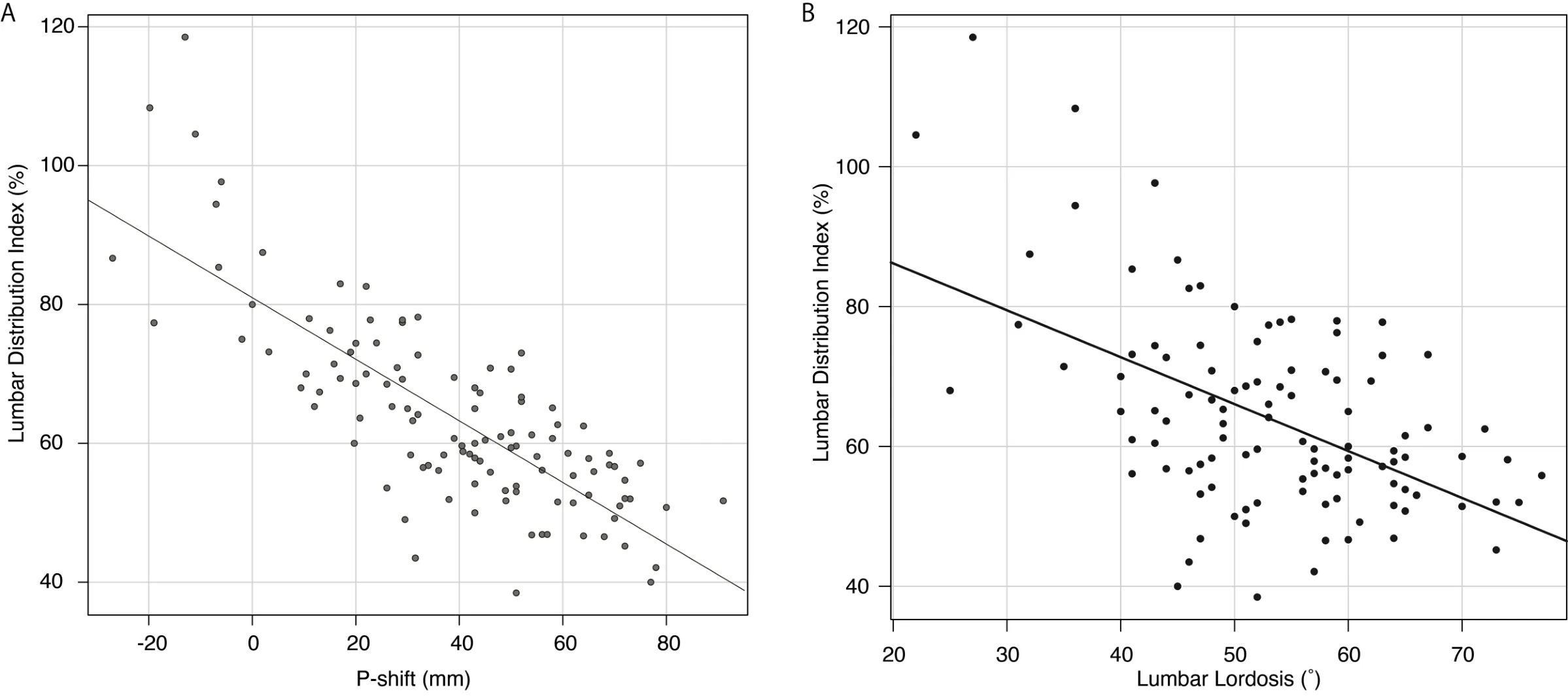
In volunteers, P-shift correlated significantly with LL, PI, and LDI (R² = 0.71), with the strongest association observed for LDI (Fig. 2A). P-shift also increased with increasing PI. In ASD cases, P-shift correlated with postoperative LL, postoperative LDI, and the presence of L3 pedicle subtraction osteotomy (L3PSO) (R² = 0.74). In cases without L3PSO: P-shift = 24 + 0.69LL − 0.52LDI. Although target LL is usually determined based on PI, there is no clear target for LDI. In volunteers, LDI correlated strongly with LL (r = −0.53, p < 0.0001, Fig. 2B), yielding: LDI = 100 − 0.67LL. Substituting this into the regression equation gave: P-shift = 1.04LL − 28, which can be approximated clinically as: P-shift ≈ LL − 25. In cases with L3PSO: P-shift = 15.5 + 0.8LL − 0.47LDI − 7.8. Substitution yielded: P-shift = 1.1LL − 40, which can be approximated as: P-shift ≈ LL − 35.
P-shift reflects the distribution of LL. For a given LL, a larger P-shift results in a more proximal distribution, whereas a smaller P-shift shifts lordosis distally. Restoring patient-specific sagittal alignment is important for preventing mechanical failure after ASD surgery. Our findings suggest that the target P-shift should be approximately LL − 25 without L3PSO and LL − 35 when L3PSO is performed. Because this distance can be easily measured intraoperatively, P-shift may serve as a simple and practical indicator for rod contouring and lordosis distribution.
Figures and tables
As submitted with the abstract. Tap a figure to open it at full size.