Growing Spine
Can Integrated Planning with the Gap Score and Sagittal Simulation Using Surgimap Improve Sagittal Alignmnent and Reduce Complications in Adolescent Idiopathic Scoliosis Surgery? A Retrospective Case-Matched Study of 100 Patients
- Istituto Ortopedico Rizzoli, Bologna, Italy
Abstract
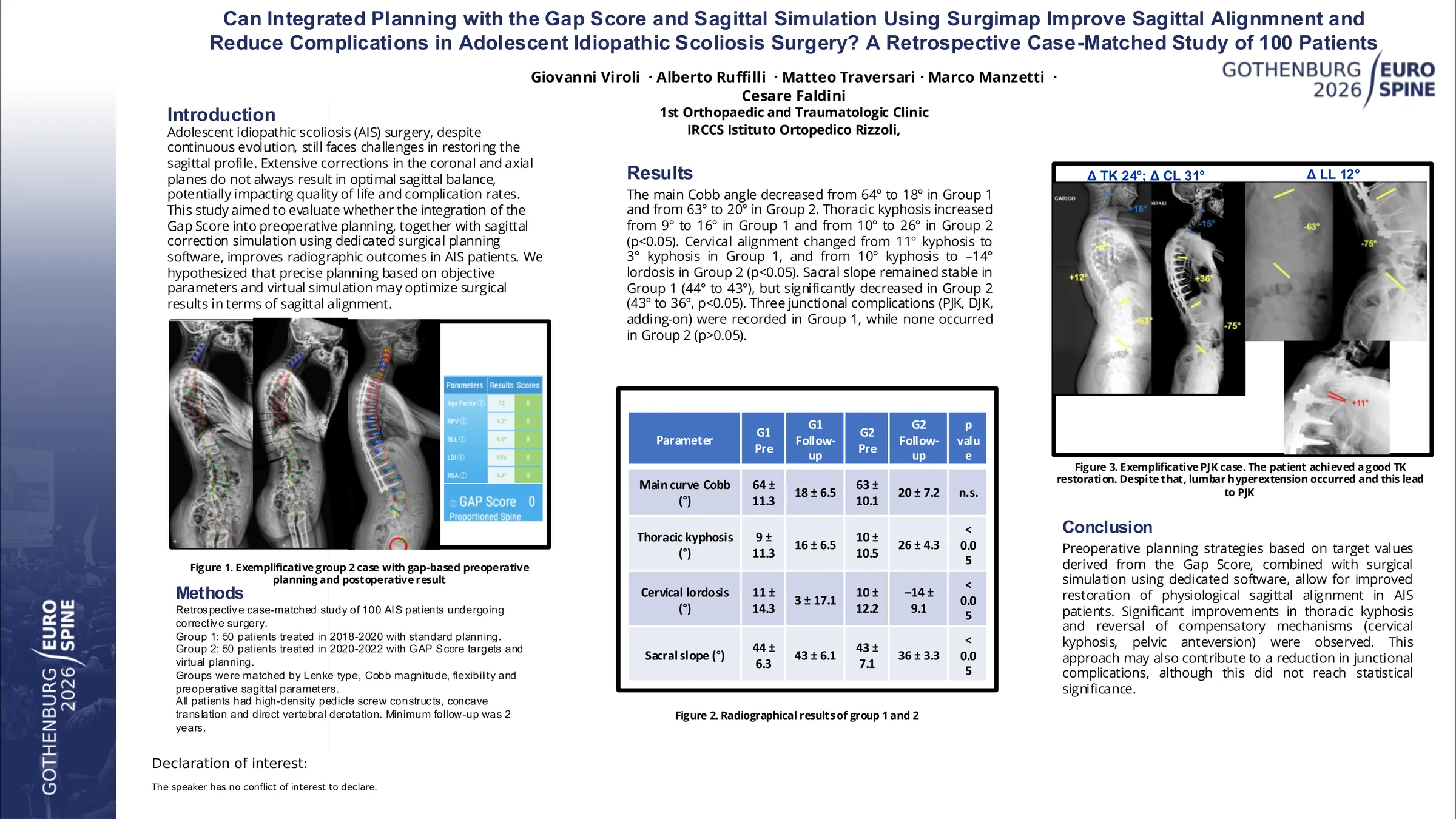
In Adolescent idiopathic scoliosis (AIS) surgery extensive corrections in the coronal and axial planes do not always result in optimal sagittal balance, potentially impacting quality of life and complication rates. This study aimed to evaluate whether the integration of the Gap Score into preoperative planning, together with sagittal correction simulation using dedicated surgical planning software, improves radiographic outcomes in AIS patients. We hypothesized that precise planning based on objective parameters and virtual simulation may optimize surgical results in terms of sagittal alignment.
A retrospective case-matched study was conducted on fifty AIS patients operated between 2020 and 2022 (Group 1) which were compared with 50 patients treated between 2022 and 2024 (Group 2). Groups were matched according to curve pattern (Lenke classification), magnitude of the main curve, curve flexibility as measured on side-bending radiographs, and preoperative sagittal alignment parameters including thoracic kyphosis, lumbar lordosis, and pelvic parameters. All patients underwent the same surgical technique consisting of high-density pedicle screw constructs, concave translation, and direct vertebral derotation maneuvers, performed by the same surgical team. In addition, Group 2 received a dedicated preoperative planning protocol: the surgical target was determined using the Gap Score, and the planned correction was virtually simulated with specialized software to predict postoperative sagittal alignment and optimize implant positioning. Patients were between 10 and 18 years of age at the time of surgery and had a minimum follow-up of two years. Standardized radiographic parameters (Cobb angle, thoracic kyphosis, cervical lordosis, sacral slope, and junctional angles) were assessed on standing anteroposterior and lateral radiographs both preoperatively and at the latest follow-up.
The main Cobb angle decreased from 64° to 18° in Group 1 and from 63° to 20° in Group 2. Thoracic kyphosis increased from 9° to 16° in Group 1 and from 10° to 26° in Group 2 (p<0.05). Cervical alignment changed from 11° kyphosis to 3° kyphosis in Group 1, and from 10° kyphosis to –14° lordosis in Group 2 (p<0.05). Sacral slope remained stable in Group 1 (44° to 43°), but significantly decreased in Group 2 (43° to 36°, p<0.05). Three junctional complications (PJK, DJK, adding-on) were recorded in Group 1, while none occurred in Group 2 (p>0.05).
Preoperative planning strategies based on target values derived from the Gap Score, combined with surgical simulation using dedicated software, allow for improved restoration of physiological sagittal alignment in AIS patients. Significant improvements in thoracic kyphosis and reversal of compensatory mechanisms (cervical kyphosis, pelvic anteversion) were observed.