
Degenerative Thoracolumbar
Analysis of Risk Factors for Adjacent Segment Facet Joint Degeneration Following Lumbar Fusion: A 10-Year Retrospective Cohort Study
- nantong first people hospital, nantong, China
- Nantong First People's Hospital, nantong, China
Abstract
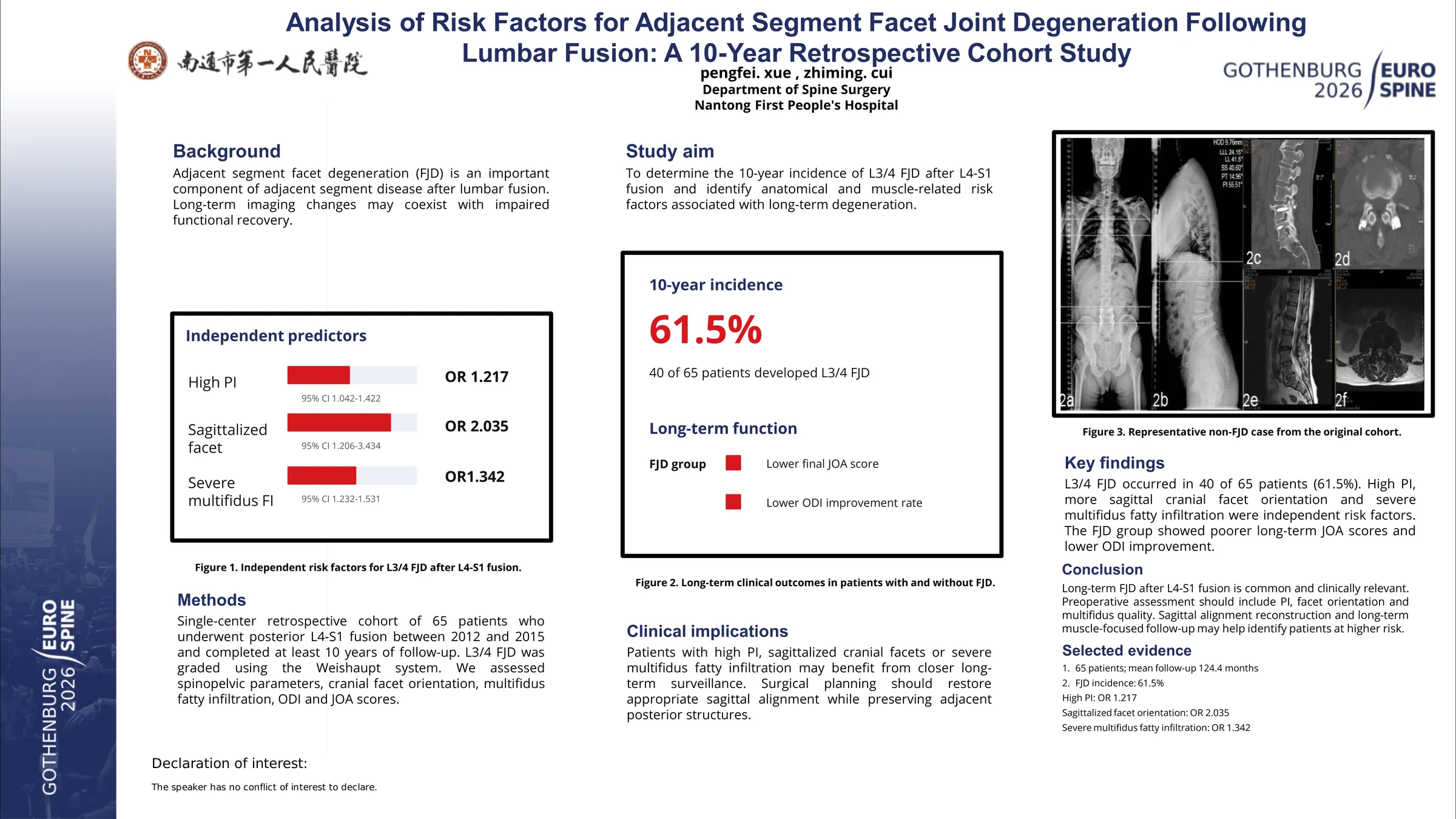
To identify 10-year risk factors for proximal adjacent segment (L3/4) facet joint degeneration (FJD) following L4-S1 lumbar fusion.
A retrospective analysis was conducted on 65 patients who underwent L4-S1 posterior fusion between 2012 and 2015 with a follow-up of ≥10years. Based on the Weishaupt grading system, the L3/4 segment was categorized into a degeneration group (n=40) and a non-degeneration group (n=25).Spino-pelvic parameters [lumbar lordosis (LL), pelvic incidence (PI), pelvic tilt (PT), sacral slope (SS), and height of disc (HOD)], cranial facet joint angles,and multifidus FI% were compared. Multivariable logistic regression identified risk factors for FJD, while ODI and JOA scores assessed clinical outcomes.
Baseline characteristics were balanced (P>0.05). At the 10-year mark, the degeneration group exhibited significantly higher PI (58.28°±7.03°), PT(19.72°±6.96°), and cranial facet angles (59.68°±3.40°) compared to the non-degeneration group (P<0.05). Multivariable regression confirmed that high PI(OR=1.217, 95% CI: 1.042-1.422), facet joint sagittalization (OR=2.035, 95% CI: 1.206-3.434), and severe multifidus FI (OR=1.342, 95% CI: 1.232-1.531)were independent risk factors for long-term FJD. Clinical efficacy (ODI improvement and JOA scores) was significantly lower in the degeneration group(P<0.05).
Long-term FJD is primarily driven by high pelvic incidence, facet sagittalization, and paraspinal muscle atrophy. Optimizing sagittal alignmentand perioperative muscle training are essential to mitigate adjacent segment degeneration.