
Tumours & Infection
Tumor-Specific Survival Changes After Surgery for Metastatic Spinal Cord Compression: A 15-Year Comparative Cohort Study
- Rigshospitalet, Copenhagen, Denmark
- Rigshospitalet, Copenhagen East, Denmark
Abstract
Prognostic scoring systems for metastatic spinal cord compression (MSCC) are based on historical tumor-specific survival estimates. Advances in systemic oncological treatment may have altered contemporary prognosis within individual tumor entities. This study evaluated changes in tumor-stratified survival after surgery for MSCC.
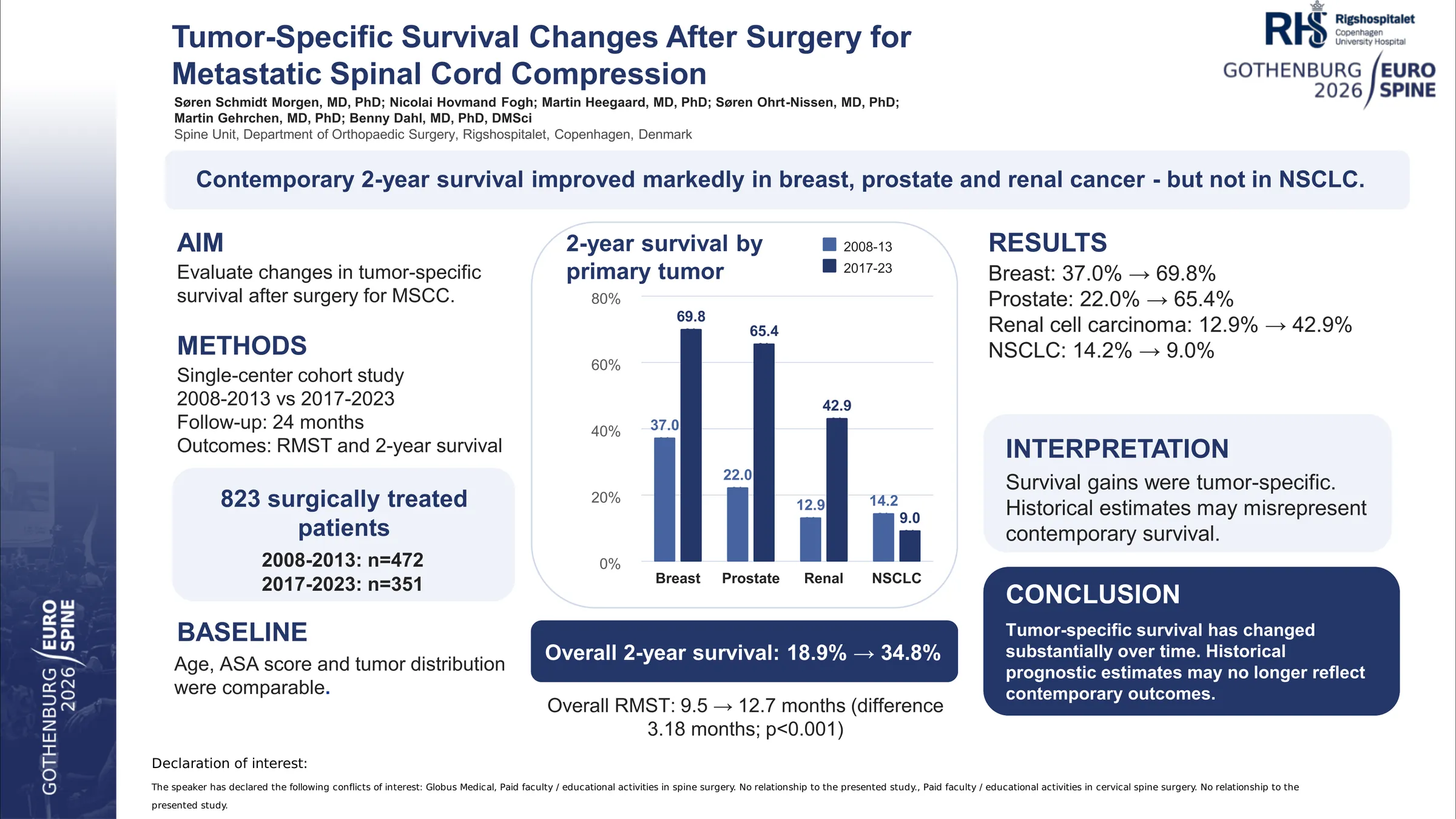
Patients treated surgically for MSCC in 2008–2013 and 2017–2023 were included in this one-center cohort study. Patients were followed for up to 2 years after surgery or until death, whichever occurred first. Baseline variables included age, sex, ASA score, BMI and tumor type focusing on the four most frequent tumor types: Non-Small Cell Lung Cancer (NSCLC), prostate, breast and renal cell carcinoma. Survival was analyzed using restricted mean survival time (RMST) over 24 months and Kaplan–Meier 2-year survival proportions.
A total of 823 patients were included, 472 in 2008–2013 and 351 in 2017–2023. Between the two study periods, we found no differences in age, ASA-score or tumor distribution. Minor differences were observed in BMI (p=0.033) and sex distribution.
Overall RMST increased from 9.5 months (95% CI 8.7–10.3) in 2008–2013 to 12.7 months (95% CI 11.7–13.7) in 2017–2023 (difference 3.18 months, p<0.001). Two-year survival increased from 18.9% (95% CI 15.3–22.4) to 34.8% (95% CI 29.8–39.7).Breast cancer survival at 2 years increased from 37.0% (25.9–48.1) to 69.8% (56.0–83.5).Prostate cancer increased from 22.0% (11.5–32.6) to 65.4% (47.1–83.7).Renal cell carcinoma increased from 12.9% (1.1–24.7) to 42.9% (21.7–64.0).In contrast, NSCLC showed no improvement (14.2% [8.1–20.2] vs 9.0% [2.1–15.8]).
Although the present study may reflect a change in patient selection, it may also reflect the general improved survival in breast, prostate and renal cancer over the past decade. These shifts in tumor-specific survival suggest that historical prognostic estimates may no longer reflect current survival outcomes and should be reassessed to optimize prognostic assessment and surgical decision-making.