
Degenerative Thoracolumbar
Three-Dimensional vs Two-Dimensional Visualization in Unilateral Biportal Endoscopic (UBE) Spine Surgery: A Randomized Crossover Simulation Feasibility Study
- HOCH Health Ostschweiz, St. Gallen, Switzerland, St. Gallen, Switzerland
- University of Freiburg - Department of Neurosurgery, Freiburg im Breisgau, Germany
Abstract
Three-dimensional (3D) endoscopic visualization is believed to improve depth perception and surgical performance compared with conventional two-dimensional (2D) systems. However, evidence supporting its use in unilateral biportal endoscopic (UBE) spine surgery remains limited.
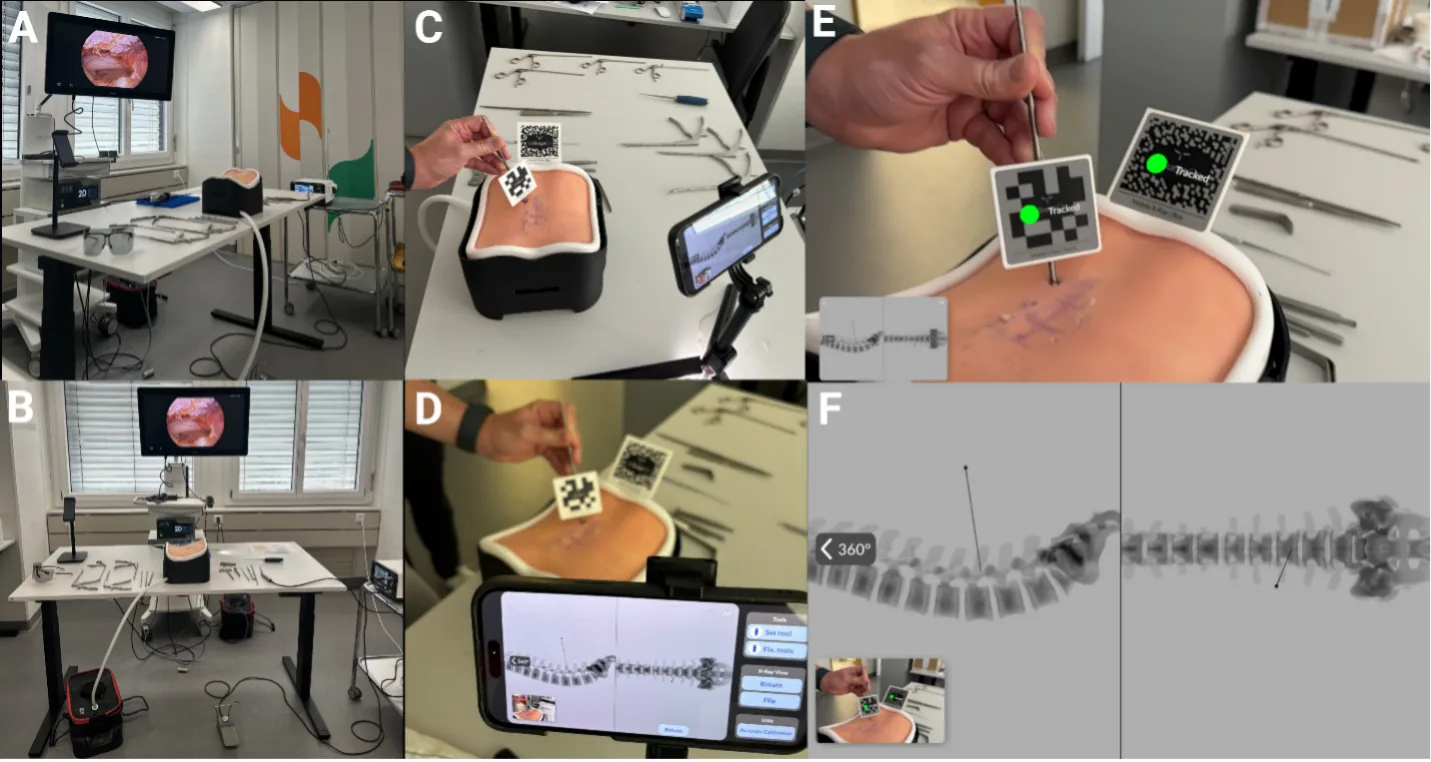
This randomized crossover pilot feasibility ex vivo study enrolled 6 neurosurgeons (3 residents, 3 seniors) who each completed a standardized UBE lumbar discectomy simulation (UpSurgeOn Lumbar SpineBox) under both 3D and 2D visualization in a randomized sequence. The primary outcome was composite procedural performance (0-100 scale) assessed using a multi-item checklist encompassing technical success, quality, and safety. Secondary outcomes included task completion times for 7 procedural steps and subjective workload. Linear mixed-effects models adjusted for expertise level, spinal segment, procedural side, and session order.
All participants performed procedures with 2D and 3D endoscopy (24 procedures in total). Composite performance was high with both modalities: unweighted scores 89.7±5.0 (2D) versus 90.4±5.8 (3D), adjusted difference 0.64 points (95% CI: -3.67 to 4.96, p=0.758); weighted scores 90.4±6.6 (2D) versus 92.1±6.9 (3D), adjusted difference 1.67 points (95% CI: -4.04 to 7.37, p=0.546). Seniors completed lamina drilling 101 seconds faster with 3D (p=0.039), while residents required 563 seconds longer for dura identification with 3D (p=0.022). Subjective workload did not differ between modalities (p=0.667).
3D visualization demonstrated feasibility without improving overall performance in UBE surgery simulation. Task-specific effects differed by experience level, suggesting potential for targeted educational applications while supporting training flexibility with either modality.
Figures and tables
As submitted with the abstract. Tap a figure to open it at full size.