
Complications & Epidemiology
Safety of Lumbar Decompression Surgery in Patients Receiving Chronic Oral Anticoagulation: A Propensity Score–Matched Study
- New Tokyo Hospital, Matsudo, Japan
- Chiba University School of Medicine, Chiba, Japan
Abstract
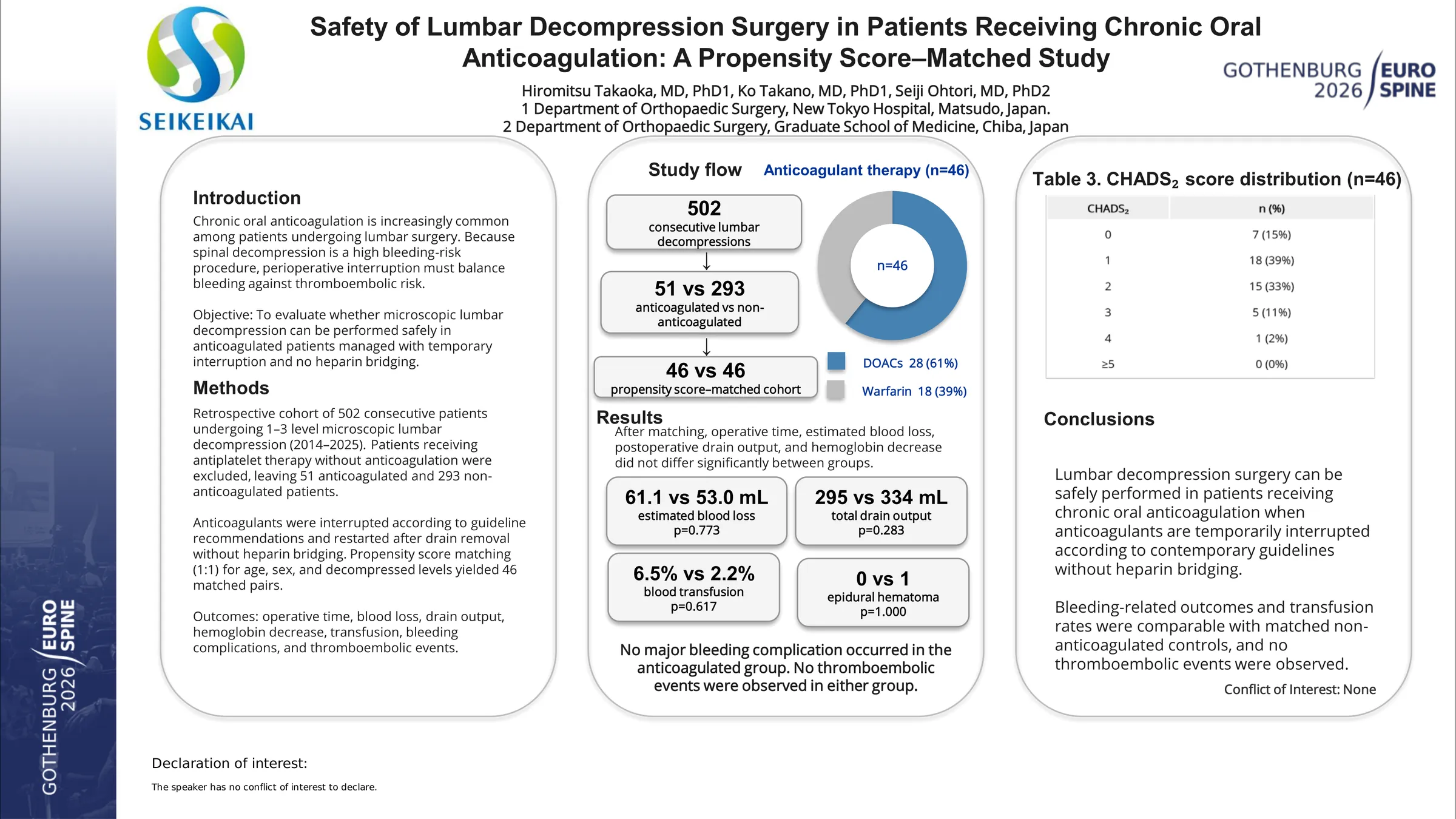
With population aging, an increasing number of patients undergoing lumbar decompression surgery receive chronic oral anticoagulation. Although lumbar decompression is considered a high bleeding-risk procedure, evidence regarding perioperative safety in anticoagulated patients remains limited. Spine surgeons therefore face uncertainty regarding bleeding and thromboembolic risks when anticoagulation is temporarily interrupted. This study evaluated the perioperative safety of lumbar decompression surgery in patients receiving chronic oral anticoagulation managed according to contemporary guidelines.
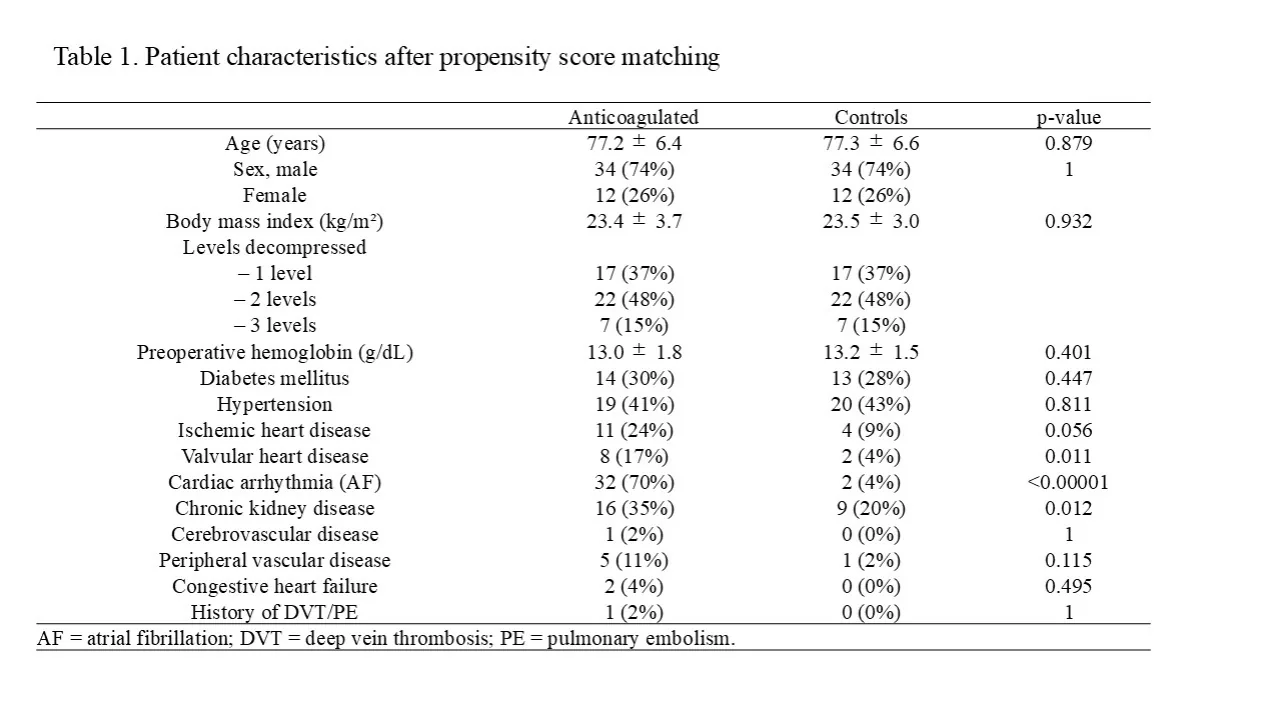
A retrospective cohort study was conducted including 502 consecutive patients who underwent one- to three-level microscopic lumbar decompression between 2014 and 2025. Among these, patients receiving antiplatelet therapy without anticoagulation were excluded. The study population therefore consisted of 51 patients receiving chronic oral anticoagulation and 293 non-anticoagulated patients. Oral anticoagulants, including warfarin and direct oral anticoagulants, were temporarily discontinued preoperatively according to guideline recommendations and restarted after drain removal without heparin bridging. Propensity score matching (1:1) was performed for age, sex, and number of decompressed levels to minimize confounding, resulting in 46 matched anticoagulated patients and 46 non-anticoagulated controls. Perioperative outcomes included operative time, estimated blood loss, postoperative drain output, perioperative hemoglobin decrease, blood transfusion, bleeding-related complications, and thromboembolic events.
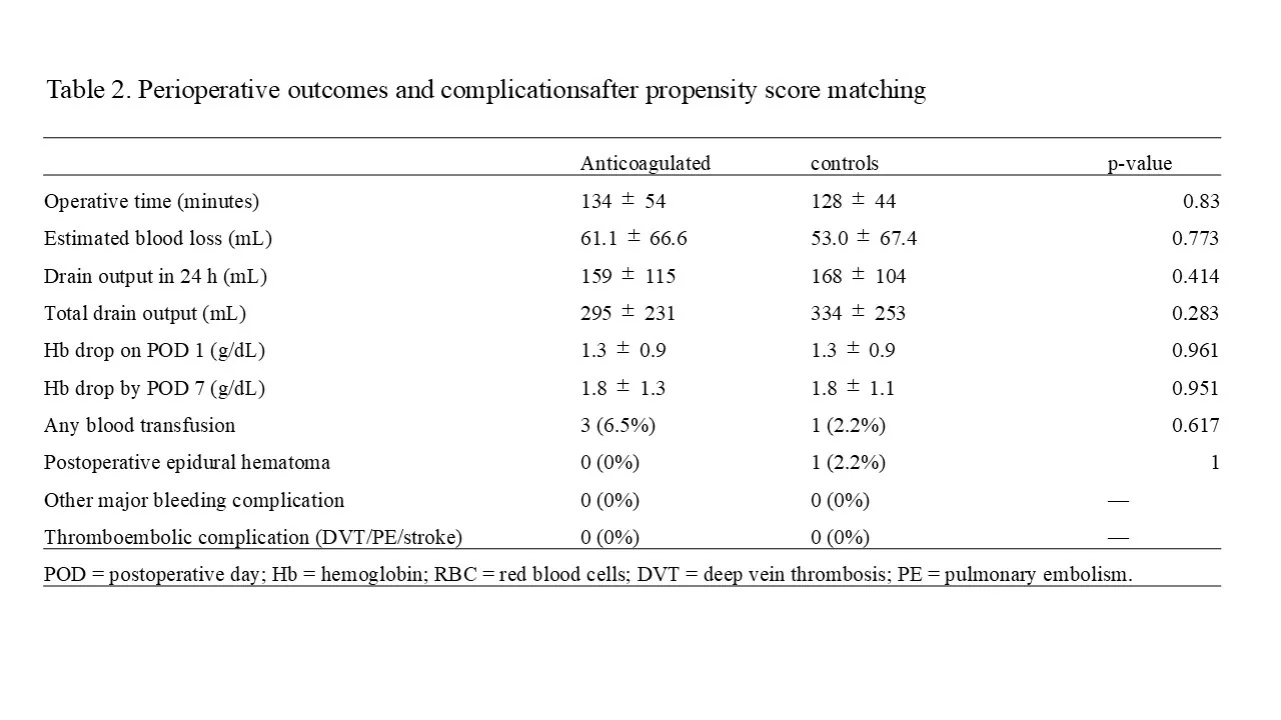
Forty-six patients receiving oral anticoagulation were successfully matched with 46 non-anticoagulated controls. Mean operative time and estimated blood loss were comparable between groups, with low estimated blood loss observed in both cohorts. Postoperative drain output and hemoglobin decrease on postoperative days 1 and 7 did not differ significantly. Blood transfusion was required in 6.5% of anticoagulated patients and 2.2% of controls. No patient in the anticoagulation group developed postoperative epidural hematoma or other major bleeding complications, while one control patient required hematoma evacuation. No thromboembolic events were observed in either group.
Lumbar decompression surgery can be performed safely in patients receiving chronic oral anticoagulation when managed with temporary interruption according to contemporary guidelines and without heparin bridging. Perioperative bleeding, transfusion rates, and thromboembolic complications were comparable to those in non-anticoagulated patients.
Figures and tables
As submitted with the abstract. Tap a figure to open it at full size.