Adult Deformity
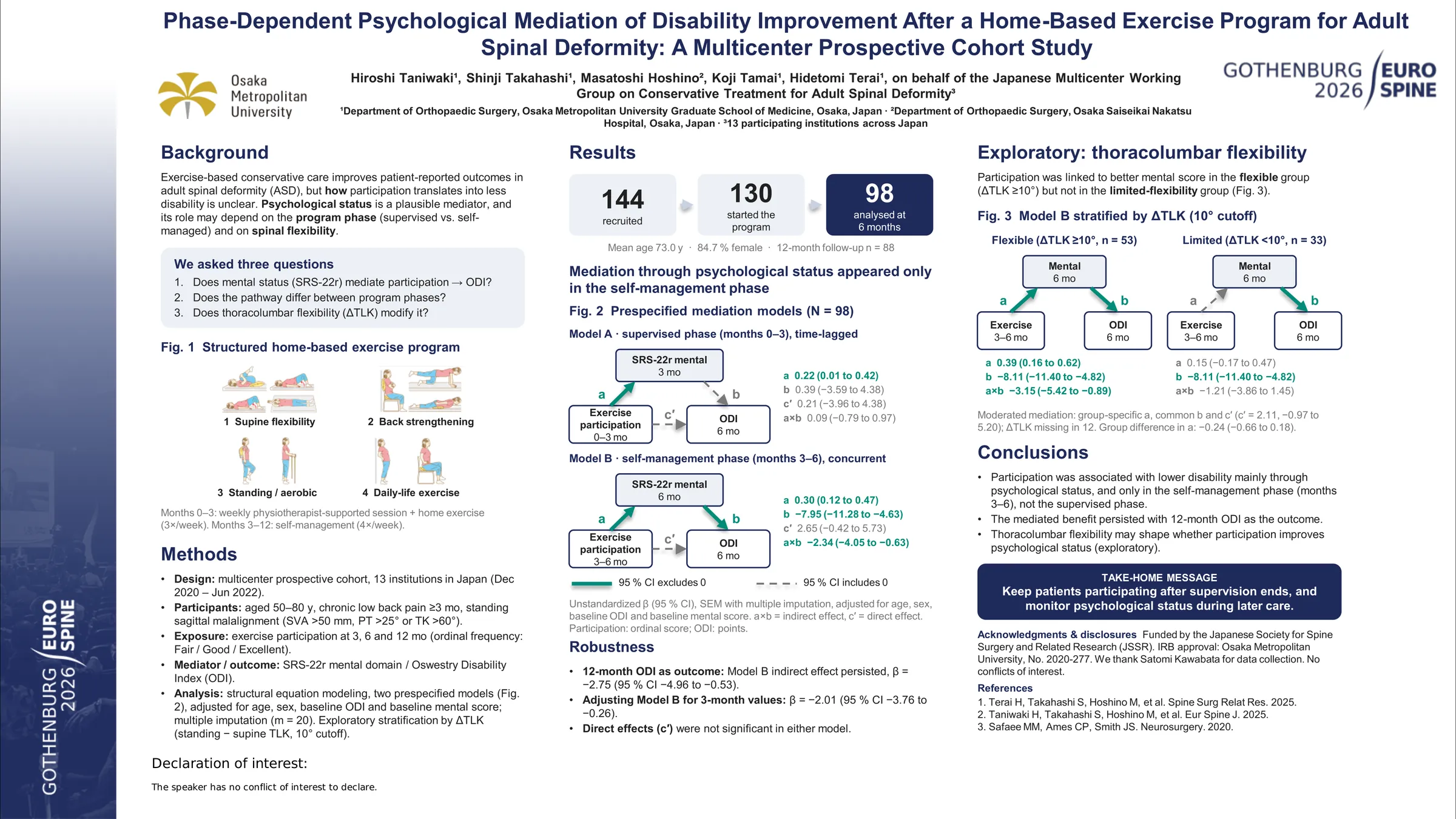
Phase-Dependent Psychological Mediation of Disability Improvement After a Home-Based Exercise Program for Adult Spinal Deformity: A Multicenter Prospective Cohort Study
- Osaka Metropolitan University Graduate School of Medicine, Osaka, Japan
- Osaka Saiseikai Nakatsu Hospital, Osaka, Japan
- Niigata Spine Surgery Center, Kameda Daiichi Hospital, Niigata, Japan
- Orthotics and Assitive Technology, Niigata University of Health and Welfare, Niigata, Japan
- Wakayama Medical University, Wakayama, Japan
- Hamamatsu University School of Medicine, Hamamatsu, Japan
- Wajokai Eniwa Hospital, Hokkaido, Japan
- Tailor Made Back pain Clinic, Tokyo, Japan
- Institute of Science Tokyo, Tokyo, Japan
- Akita University Graduate School of Medicine, Akita, Japan
- University of Yamanashi School of Medicine, Chuo, Japan
- Wakayama Medical University, Wakayama, Wakayama, Japan
- Osaka Rosai Hospital, Osaka, Japan
Abstract
Exercise-based conservative care can improve patient-reported outcomes in adult spinal deformity (ASD), but the mechanisms linking exercise participation to disability improvement are unclear. We tested whether psychological status mediates the association between participation and disability, whether this pathway differs by program phase, and whether thoracolumbar flexibility is associated with heterogeneity in this pathway.
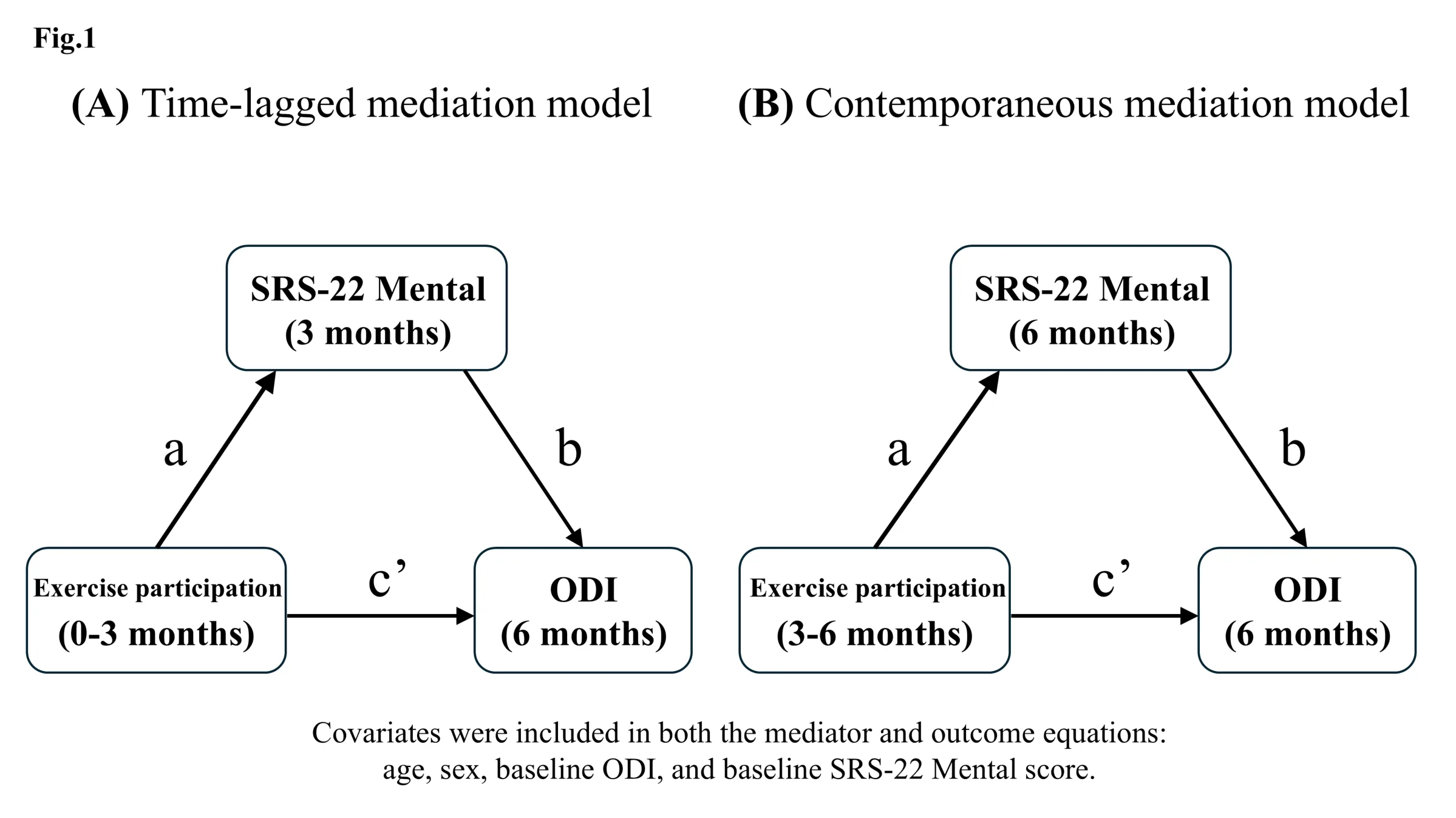
This multicenter prospective cohort study enrolled adults aged 50–80 years with chronic low back pain and standing sagittal malalignment at 13 institutions. Participants performed a structured home-based program with weekly physiotherapist support in months 0–3 and self-management thereafter. Participation was assessed at 3, 6, and 12 months using a 3-level ordinal frequency scale. Disability was measured by the Oswestry Disability Index (ODI), and psychological status by the SRS-22r mental domain. Two prespecified mediation models were estimated using structural equation modeling adjusted for age, sex, baseline ODI, and baseline SRS-22r mental score: Model A (0–3-month participation → 3-month mental → 6-month ODI) and Model B (3–6-month participation → 6-month mental → 6-month ODI) (Fig.1). Model B was also applied with 12-month ODI as the outcome. Exploratory analyses stratified participants by thoracolumbar flexibility using the standing–supine thoracolumbar kyphosis (TLK) difference (10° cutoff).
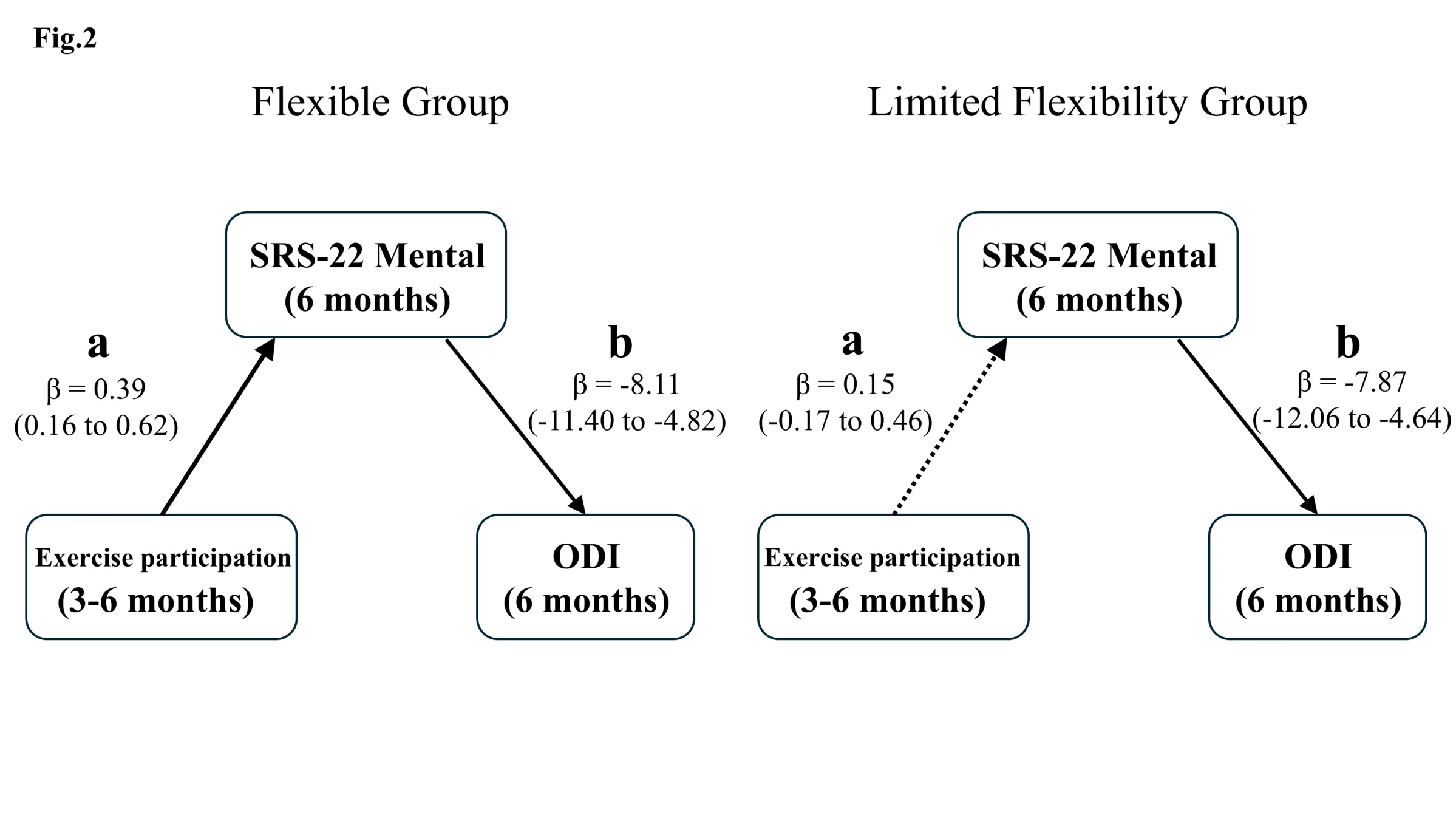
Of 144 recruited participants, 130 initiated the intervention; the 6-month analytic cohort included 98 (mean age 73.0 years; 84.7% female). In Model A, participation was associated with 3-month mental score (path a: β=0.22; 95% CI 0.01–0.42), but the 3-month mental score was not associated with 6-month ODI (path b: β=0.4; 95% CI −3.59–4.37); the indirect effect was not supported (β=0.09; 95% CI −0.79–0.97). In Model B, participation was associated with 6-month mental score (path a: β=0.30; 95% CI 0.12–0.47), and 6-month mental score was associated with lower 6-month ODI (path b: β=−7.95; 95% CI −11.28 to −4.63); the indirect effect was significant (β=−2.34; 95% CI −4.05 to −0.63). The indirect effect remained significant when 12-month ODI was used as the outcome. In exploratory ΔTLK-stratified analyses, the participation–mental association was evident in the flexible group but not in the limited-flexibility group (Fig.2).
Participation in a structured home-based exercise program was associated with lower disability predominantly through psychological status at 6 months, and this pattern was preserved when 12-month ODI was used as the outcome. Exploratory findings suggest that thoracolumbar flexibility may be related to heterogeneity in the participation-to-psychological pathway. These findings highlight the importance of sustaining participation beyond the supervised phase and monitoring psychological status during later care.
Figures and tables
As submitted with the abstract. Tap a figure to open it at full size.