
Degenerative Thoracolumbar
Lumbar total disc replacement for treatment of lumbar spondylolisthesis
- Matilda International Hospital, Hong Kong, Hong Kong
Abstract
Lumbar degenerative disc disease is a common problem. It is estimated that degenerative lumbar spondylolisthesis exists in up to 17% of 50-64-year-old age group and 25% of those over age 65.
Spondylolisthesis is often associated with spinal stenosis.
Lumbar total disc replacement has been demonstrated to be effective for treating lumbar degenerative disc disease. Improvements after surgery are rapid and sustained.
There are very little or no reports of total disc replacement for treatment of spondylolisthesis.
Decompression of spinal stenosis is via anterior distractive ligamentotaxis and indirect decompression alone with additional reduction of spondylolisthesis.
5-year period from October 2018 to February 2024 with minimum 2 year follow up.
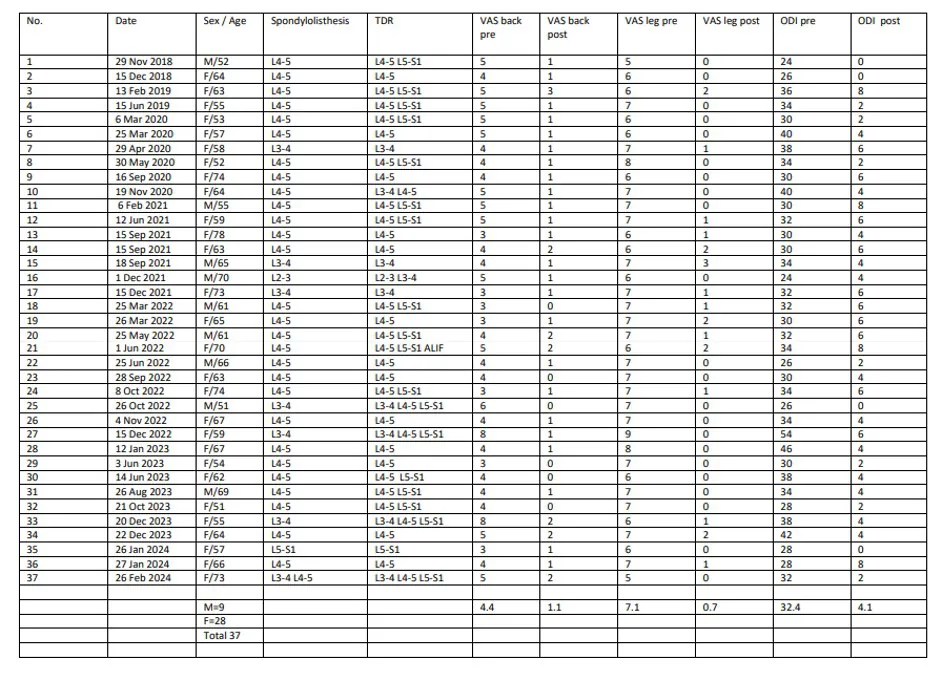
There were a total of 37 patients 9 males 28 females with spondylolisthesis and spinal stenosis treated with lumbar total disc replacement after failed conservative management.
All patients were assessed in terms of back and leg pain Visual Analogue Scale VAS and Oswestry Disability Index ODI at standard time points. Plain radiographs were available pre operatively and post operatively at 2 weeks, 6 weeks, 3 and 6 months, and at one year with yearly x ray thereafter. Pre-operative MRI was available for some patients with post-operative MRI in some.
Patients underwent surgery from either a standard right or left retroperitoneal approach with a single surgeon.
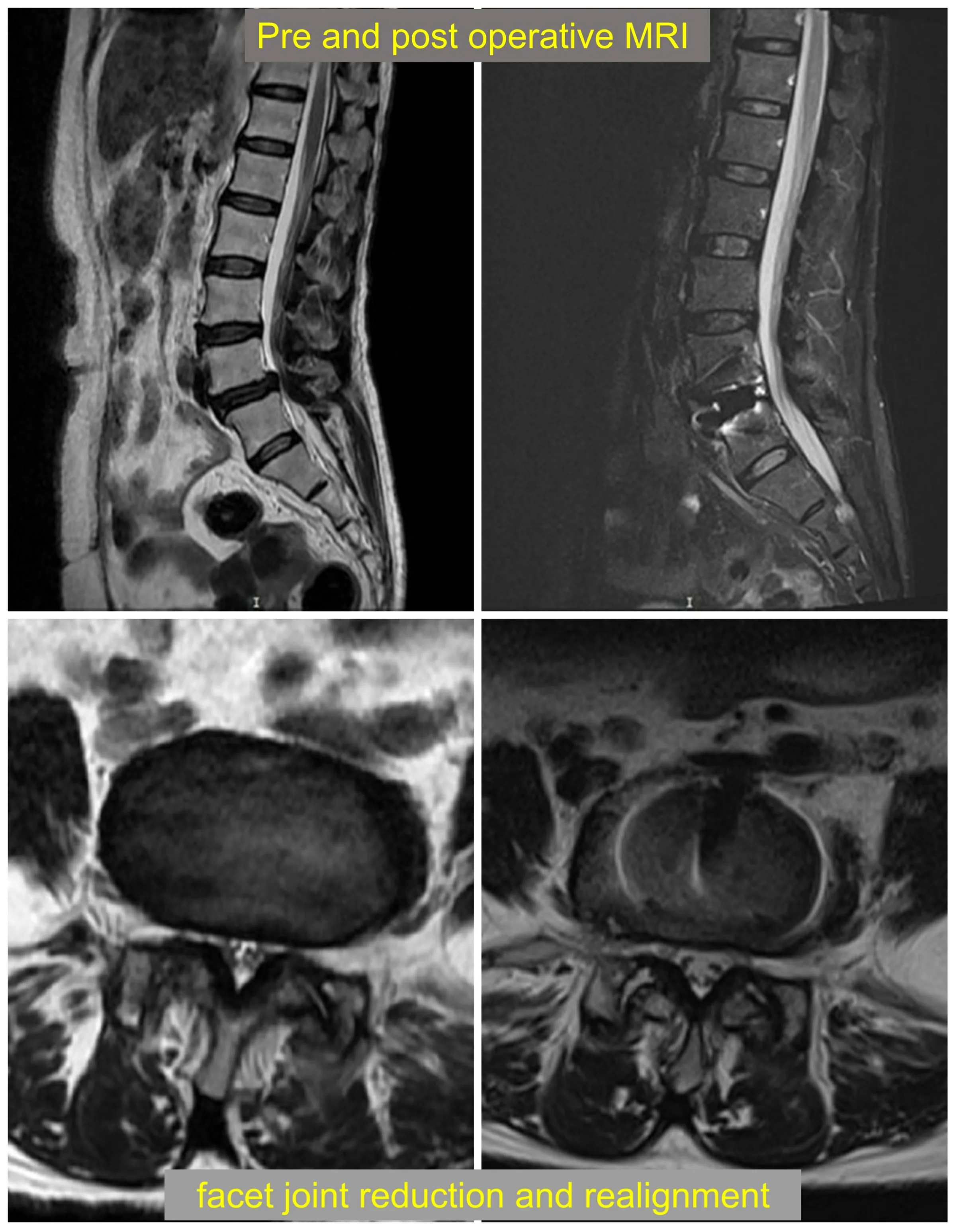
All patients had relief of stenosis symptoms. One female patient developed implant subsidence which required conversion to fusion. Average ODI improvement was from 32.4 to 4.1, VAS pain for back pain from 4.4 to 1.1 leg pain from 7.1 to 0.7. Pre and post-operative MRI for patients with post-operative MRI imaging demonstrated resolution of spinal stenosis and in some instances reduction and healing of facet joint arthropathy. Results for ODI and VAS seemed to stabilize between 6 to 12 months with minimal change thereafter at longer term follow up.
Motion was preserved in the operated segment with no evidence of new adjacent segment disease at last follow up.
Lumbar total disc replacement is a viable option for patients with degenerative lumbar spondylolisthesis. Indirect decompression is achieved via ligamentotaxis and spondylolisthesis is reduced with facet joint arthropathy improving. Compared to spinal fusion, lumbar motion is preserved with maintenance of dynamic lumbar alignment thereby reducing the risk of adjacent segment degeneration.
Figures and tables
As submitted with the abstract. Tap a figure to open it at full size.