
Tumours & Infection
Development and Validation of a Machine Learning-Guided Model to Predict ERAS Adherence after Surgery for Spinal Metastases
- zhongshan hospital fudan university, shanghai, China
Abstract
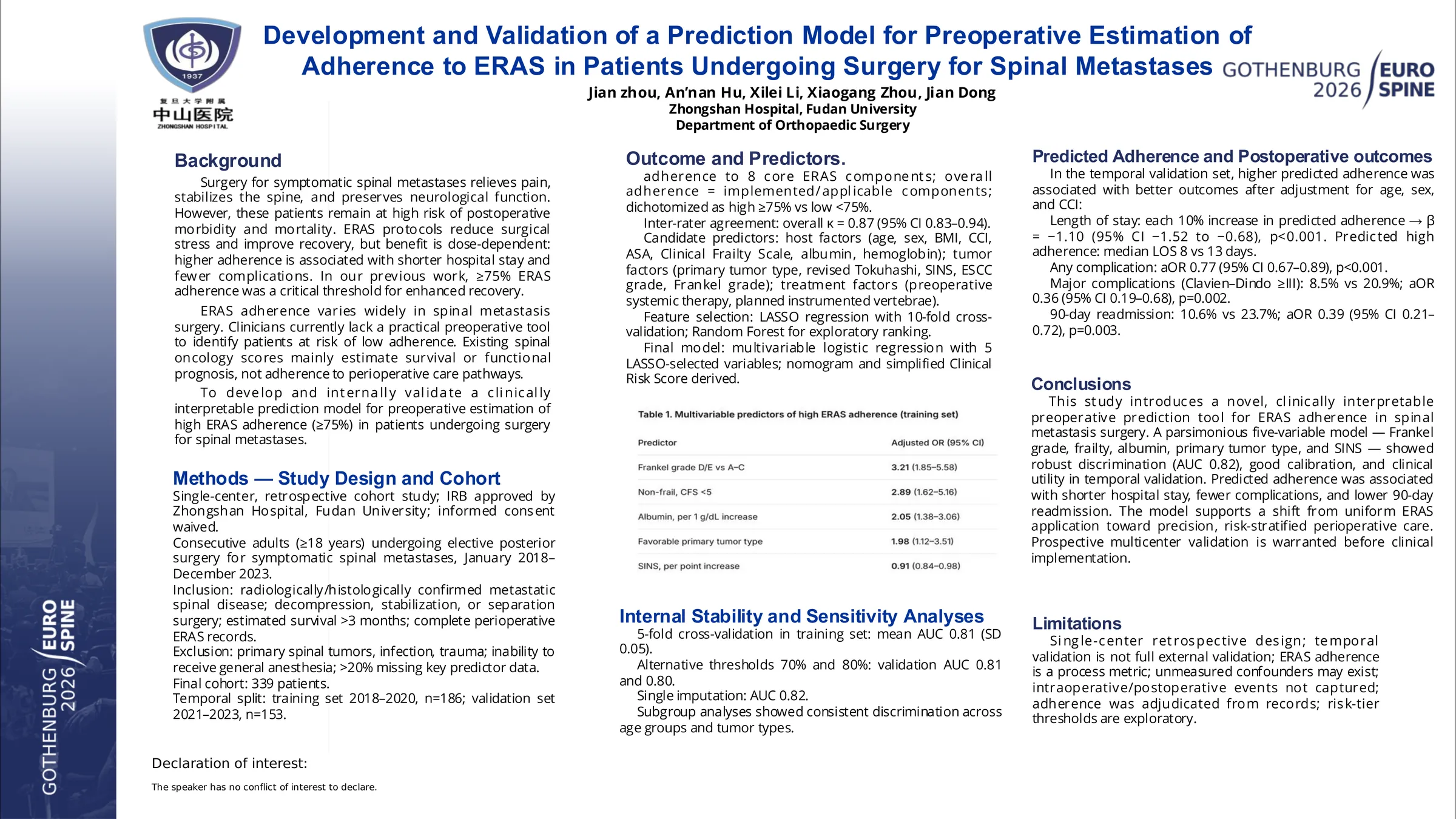
Patients undergoing surgery for spinal metastases are at high risk of postoperative complications. While Enhanced Recovery After Surgery (ERAS) protocols can improve outcomes, their benefit is contingent on high adherence, which varies significantly in practice. A practical tool to preoperatively predict adherence is lacking, hindering the implementation of personalized, risk-stratified care. This study aimed to develop and validate a machine learning-based model for the individualized preoperative prediction of high ERAS adherence (≥75%).
This single-center retrospective cohort study included patients who underwent surgery for spinal metastases between 2018 and 2023. The primary outcome was ERAS adherence, dichotomized as "High" (≥75%) based on eight core components. Predictors were collected within a host-tumor-treatment framework. The cohort was randomly split into a development set (70%) and a validation set (30%). Feature selection was performed using LASSO regression, with a multivariable logistic regression model as the final predictor. Model robustness was assessed via Random Forest and SHAP analysis. Performance was evaluated by discrimination (Area Under the Curve, AUC), calibration (calibration plots, Hosmer-Lemeshow test), and clinical utility (Decision Curve Analysis).
The final model incorporated five key predictors: better preoperative neurological status (Frankel D/E), non-frail status, higher preoperative albumin, favorable primary tumor type, and a lower Spinal Instability Neoplastic Score (SINS). The model demonstrated robust discrimination, with an AUC of 0.80 (95% CI: 0.71–0.89) in the independent validation set, and good calibration. Decision Curve Analysis indicated a net clinical benefit across a wide range of threshold probabilities (20%-55%). A user-friendly nomogram and a simplified clinical risk score were derived.
This study presents the first machine learning-guided model to preoperatively predict ERAS adherence in spinal metastasis surgery. By integrating routinely available host, tumor, and treatment factors, the model shows strong predictive performance and clinical utility. It provides a practical tool for risk stratification, facilitating targeted prehabilitation and moving towards a precision ERAS paradigm for this vulnerable population. Prospective multicenter validation is warranted.