
Cervical & Neural Pathologies
Cervical Paraspinal Muscle Fatty Infiltration as a Marker of Frailty and Predictor of Perioperative Outcomes in Posterior Cervical Decompression and Fusion
- Medical University of South Carolina, Charleston, SC, United States of America
Abstract
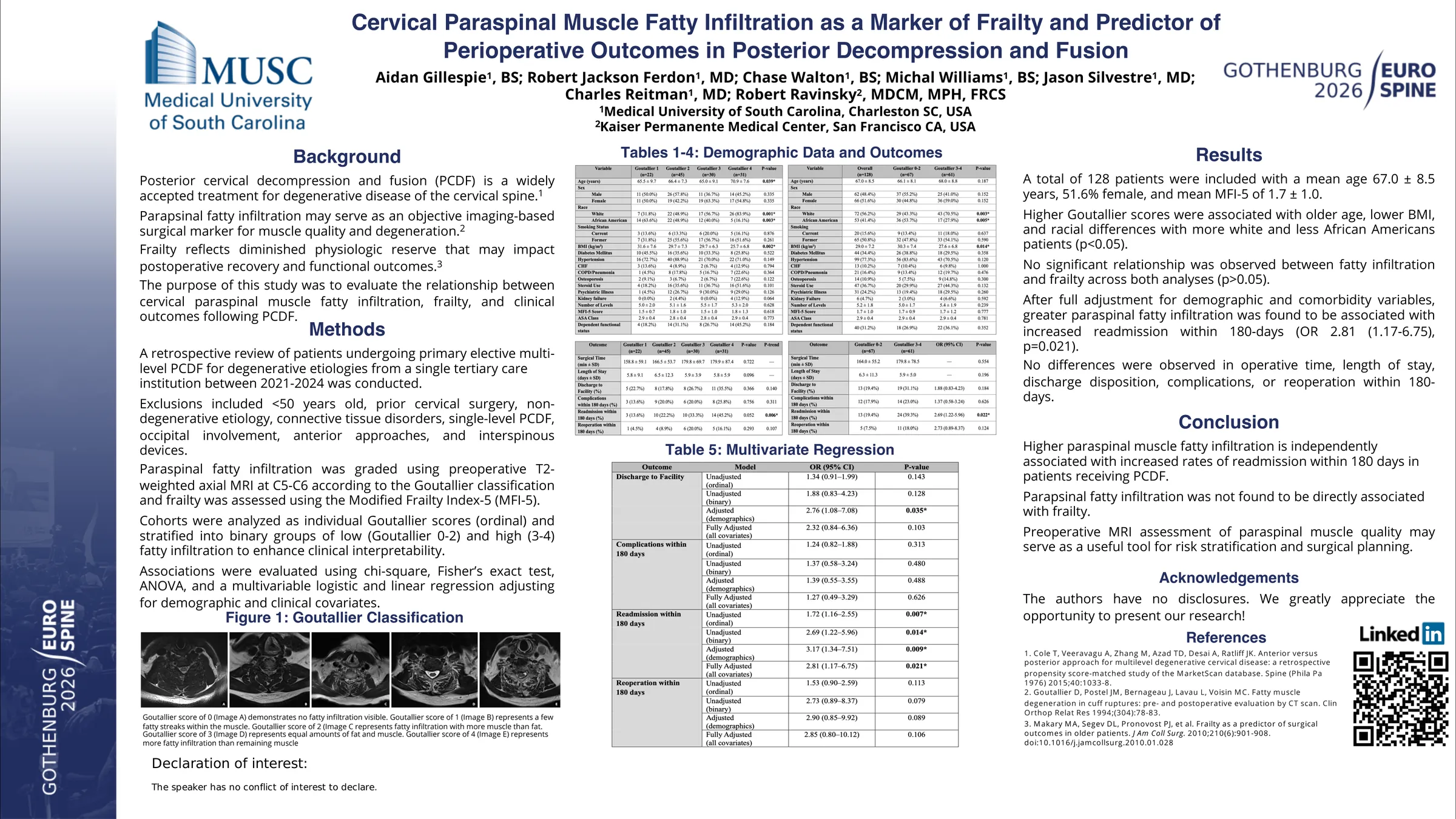
The purpose of this study was to evaluate the role of cervical paraspinal muscle fatty infiltration as a marker of frailty and as a predictor of perioperative outcomes among patients undergoing posterior cervical decompression and fusion (PCDF) for cervical degenerative disease.
A retrospective review was performed of patients older than 50 years undergoing primary multi-level PCDF for degenerative etiologies between 2021 and 2024 at a single tertiary care institution. Paraspinal muscle fatty infiltration was graded using preoperative T2-weighted axial magnetic resonance imaging at the C5-C6 level according to the Goutallier classification. Cohorts were analyzed individually and stratified into two groups: Low (scores 0–2) and High (scores 3–4) fatty infiltration. Frailty was concurrently assessed using the Modified Frailty Index-5 (MFI-5). Relationships between demographics, MFI-5, Goutallier scores, and postoperative outcomes were analyzed using chi-squared analyses, Fisher's exact test, analysis of variance, and multivariable logistic and linear regression.
A total of 128 patients were included, with a mean age of 67.0 ± 8.5 years, 51.6% female, and a mean MFI-5 score of 1.7 ± 1.0. Higher individual Goutallier scores were associated with older age (p = 0.039), lower BMI (p = 0.002), lower HbA1c (p = 0.037), and significant differences in racial distribution, with higher proportions of White patients (p = 0.001) and lower proportions of African American patients (p = 0.003), without a significant difference in MFI-5 scores across groups (p = 0.618). No significant differences in surgical time, length of stay, discharge disposition, 180-day complication rates, or reoperation rates were observed; however, a trend toward increased readmission rates was noted (p = 0.052). Following Goutallier stratification, lower BMI (p = 0.014) and a similar racial distribution for White (p = 0.003) and African American (p = 0.005) patients persisted, again without a significant association with MFI-5 scores (p = 0.777). The High Goutallier cohort was associated with a statistically significant increased risk of 180-day readmission (p = 0.022), without significant differences in surgical time, length of stay, discharge disposition, complication rates, or reoperation rates.
Higher degrees of paraspinal muscle fatty infiltration are associated with increased 180-day readmission following PCDF. These findings suggest that preoperative MRI assessment of paraspinal muscle quality may serve as a clinically useful tool for risk stratification and surgical planning in patients undergoing posterior instrumented treatment for cervical degenerative disease.