Complications & Epidemiology
Antibiotic-Loaded Calcium Sulfate Beads in Paediatric Scoliosis Surgery: A Multicentre UK Safety and Usage Cohort Study
- Rigshospitalet, København, Denmark
- Mater Private Network, Dublin, Ireland
- The Royal London Hospital, London, United Kingdom
- St George’s University Hospitals NHS Foundation Trust, London, United Kingdom
- Evelina London Children's Hospital, London, United Kingdom
- Southampton General Hospital, Southampton, United Kingdom
- King's College London, London, United Kingdom
- Royal Devon and Exeter Hospital, Exeter, United Kingdom
Abstract
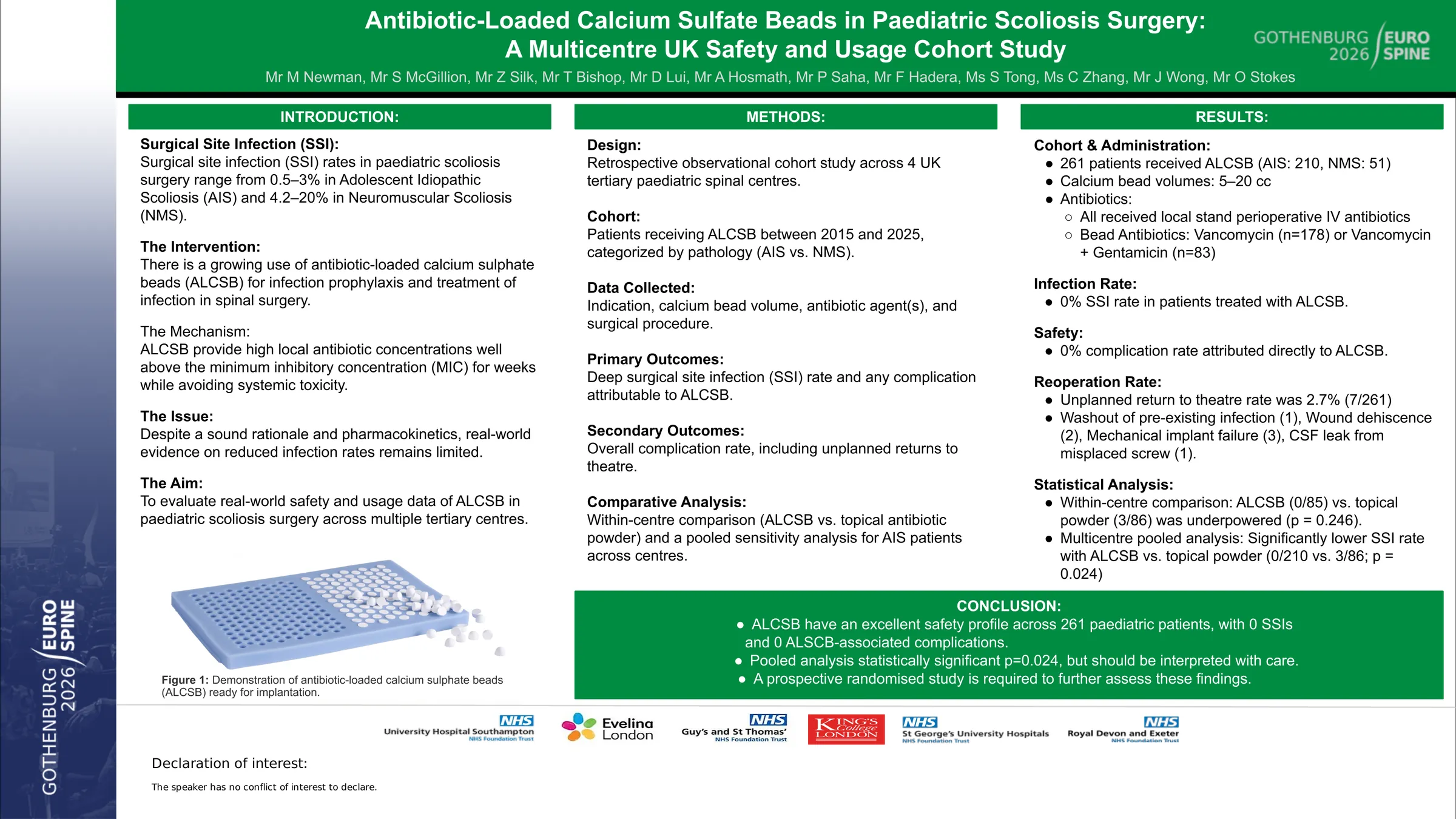
Surgical site infection (SSI) in paediatric scoliosis surgery is estimated to range from 0.5-3% for adolescent idiopathic scoliosis (AIS) and 4.2-20% for neuromuscular scoliosis (NMS). There is growing use of locally administered, antibiotic-loaded calcium sulphate beads (ALCSB), both for the treatment of established infection and as prophylaxis. ALCSB elute high local concentrations of antibiotics that are significantly above the minimum inhibitory concentration (MIC) persisting for several weeks prior to bead resorption, whilst avoiding systemic toxicity. Despite a sound pharmacokinetic rationale, evidence on reduced infection rates remains limited. This study provides real-world safety and usage data in paediatric scoliosis surgery across multiple tertiary centres.
A retrospective observational cohort study was performed across 4 tertiary paediatric spinal centres in the UK. All patients receiving ALCSB during surgery between 2015 and 2025 were included. Cases were categorised by pathology: AIS or NMS. Data collected included indication, calcium bead volume, antibiotic agent(s), and surgical procedure. Primary outcomes were deep SSI rate and any complication attributable to ALCSB. Secondary outcomes were overall complication rate, including unplanned returns to theatre. A within-centre comparison of ALCSB versus topical antibiotic powder was performed. A pooled sensitivity analysis compared all AIS patients receiving ALCSB across centres against the topical powder comparator group.
261 patients received ALCSB (AIS n=210, NMS n=51). Patients received ALCSB as prophylaxis in addition to standardised perioperative intravenous antibiotics. No complication was attributed to ALCSB. There was a 0% SSI rate in patients treated with ALCSB. ALCSB were of varying volumes ranging from 5-20cc. 83 cases received Vancomycin and Gentamicin ALCSB. 178 received Vancomycin ALCSB. Unplanned return to theatre rate was 2.7% (7/261) [(Further washout of pre-existing spinal infection (n=1), non-infected wound dehiscence requiring further suturing (n=2), mechanical implant failure (n=3), CSF leak from misplaced screw (n=1)] An initial within-centre comparison of ALCSB 0/85 (0.0%) versus topical antibiotic powder 3/86 (3.5%) for deep SSI was underpowered (Fisher's exact p=0.246). A multicentre pooled analysis demonstrated a significantly lower SSI rate with ALCSB compared to topical antibiotic powder (0/210 vs 3/86; p=0.024), though this cross-centre comparison should be interpreted cautiously.
ALCSB demonstrated an excellent safety profile across 261 paediatric patients. There were 0 SSIs and 0 ALCSB-associated complications. The pooled AIS analysis supports the use of ALCSB as an effective intraoperative SSI prophylaxis strategy. A prospective randomised study is warranted to confirm these findings.