
Degenerative Thoracolumbar
Segmental Variability of Lumbar Paraspinal Fatty Infiltration and Clinical Outcomes in Degenerative Spine Surgery
- Medical University of South Carolina, Charleston, SC, United States of America
Abstract
Degeneration of the paraspinal musculature, manifesting as fatty infiltration or sarcopenia, has emerged as an important factor in lumbar spine pathology and surgical outcomes. Imaging-based classifications of fatty infiltration, such as the Goutallier classification, has been adapted and validated in the lumbar spine; however, variability in fatty infiltration across lumbar levels and the relative prognostic values of these measurements remain poorly defined. This study characterizes lumbar segmental patterns of paraspinal fatty infiltration and evaluates associations with patient characteristics, frailty assessment scores, and clinical outcomes in patients undergoing surgery for degenerative lumbar pathology.
A retrospective review was conducted of adults ≥50 years who underwent elective one- or two-level lumbar decompressions or instrumented fusions for degenerative spinal pathology at a single institution over a 3-year period. Fatty infiltration was graded at each intervertebral level from L1–L2 to L5–S1 using the Goutallier classification. Relationships between Goutallier score, patient demographic characteristics, MFI-5 score, and postoperative outcomes were analyzed using chi-squared analysis and Fisher's exact test for categorical variables, ANOVA for continuous variables, binary logistic and linear regression models to determine independent predictors after adjusting for demographic variables and common comorbidities, and linear-by-linear analysis to evaluate ordinal trends.
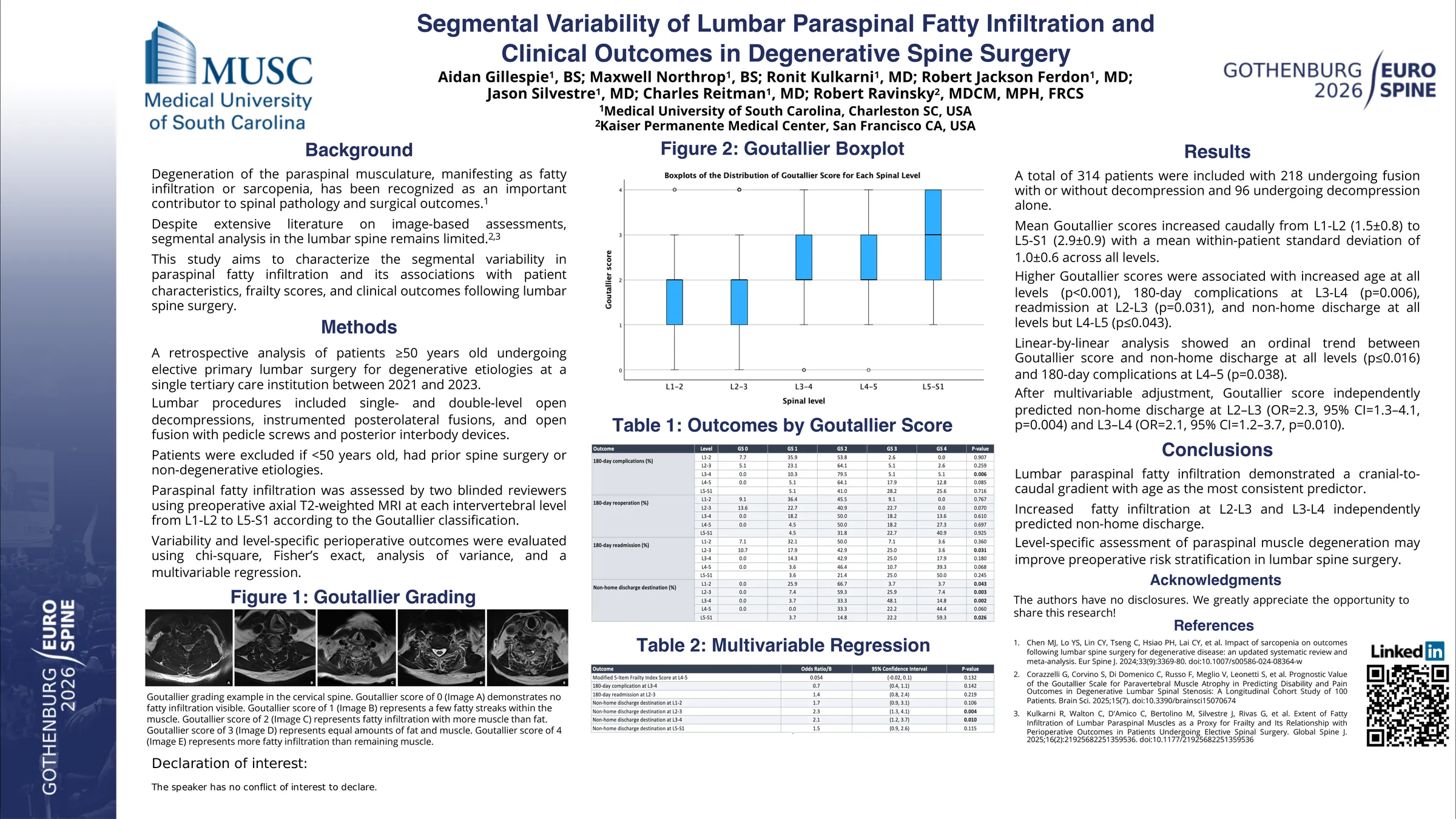
A total of 314 patients were included (53% female; 77.1% Caucasian; mean age 68.9±8.6 years; mean BMI 29.4±6.0 kg/m²), with 218 undergoing fusion with or without decompression and 96 decompression alone. Mean Goutallier scores increased caudally at each level from L1–L2 (1.5±0.8) to L5–S1 (2.9±0.9), with a mean standard deviation of 1.0±0.6 across all levels within individual patients. Higher Goutallier scores were significantly associated with increased age at all levels (P<0.001), 180-day complications at L3–4 (P=0.006), readmission at L2–3 (P=0.031), and non-home discharge across all levels (P<0.05). Linear-by-linear analyses confirmed significant ordinal trends between increasing Goutallier score and non-home discharge at all levels (P≤0.016) and 180-day complications at L4–5 (P=0.038). After multivariate adjustment, Goutallier score independently predicted non-home discharge at L2–3 (OR=2.3, 95% CI=1.3–4.1, P=0.004) and L3–4 (OR=2.1, 95% CI=1.2–3.7, P=0.010).
Lumbar paraspinal fatty infiltration demonstrated a cranial-to-caudal gradient with age as the most consistent predictor across all levels, while Goutallier scores at L2–3 and L3–4 independently predicted non-home discharge disposition. Level-specific assessment of paraspinal muscle degeneration should be incorporated into preoperative risk stratification for degenerative lumbar spine surgery patients.