Degenerative Thoracolumbar
Radiographic coronal alignment correction and risk of reoperation in adult spinal deformity: stand-alone lateral lumbar interbody fusion versus circumferential fusion
- Hospital for Special Surgery Main Hospital, New York, United States of America
- Hospital for Special Surgery Main Hospital, Zurich, Switzerland
Abstract
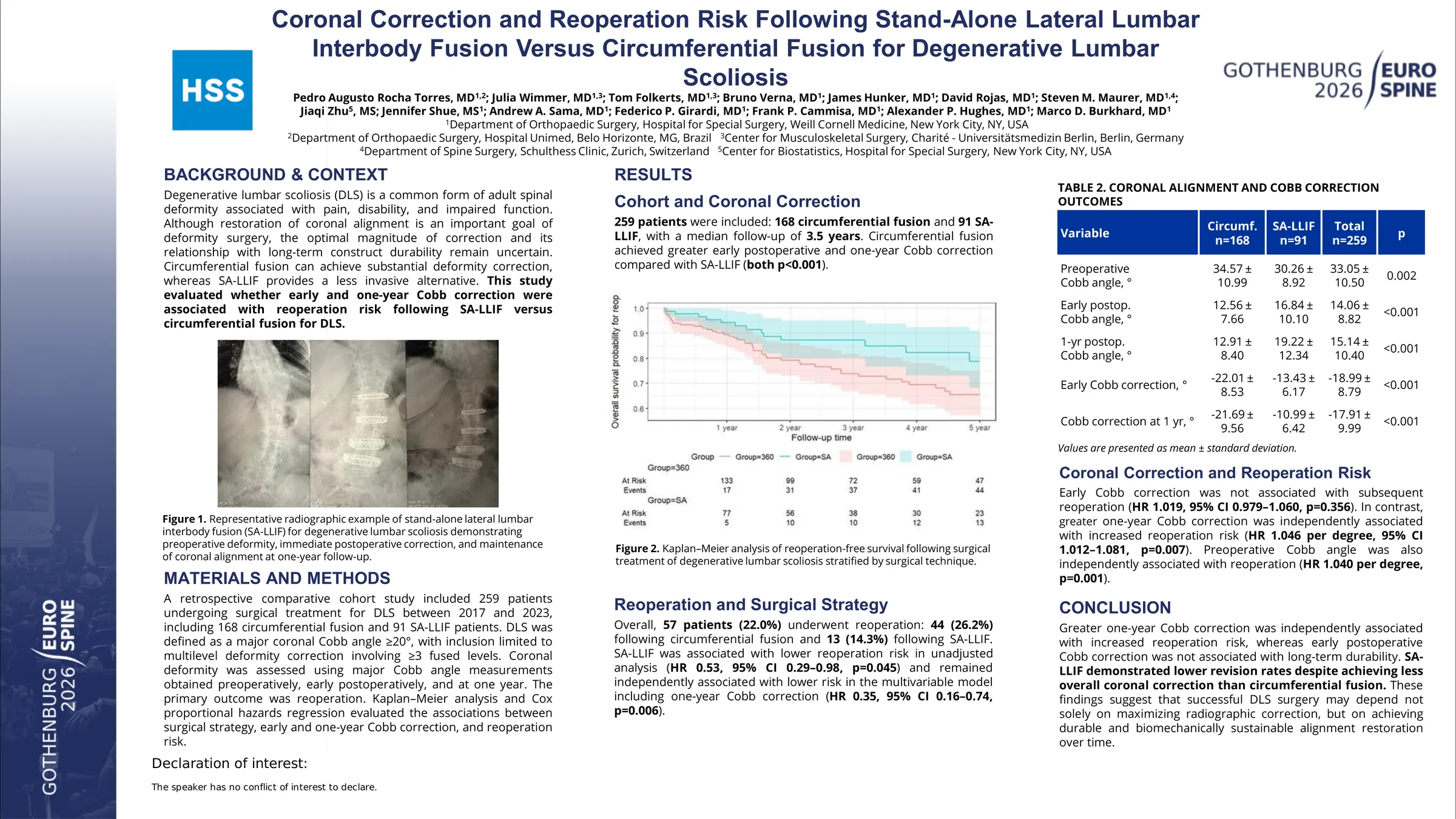
Stand-alone lateral lumbar interbody fusion (SA-LLIF) and circumferential fusion achieve different degrees of deformity correction and have reported differences in reoperation rates in adult spinal deformity. Reoperation after deformity surgery is multifactorial, and both correction magnitude and construct characteristics may influence postoperative durability. The objective of this study was to evaluate the association between coronal Cobb correction and reoperation and to determine whether surgical technique modifies this relationship.
We performed a retrospective cohort study of 259 adult spinal deformity patients treated with SA-LLIF or circumferential fusion. Reoperation was defined as any subsequent revision surgery, including construct extension or same-level revision and it was analyzed using time-to-event analysis. Radiographic predictors included early postoperative (pre-discharge) and 1-year changes in Cobb angle relative to preoperative measurements. Multivariable Cox regression models were used adjusting for age, Charlson comorbidity index, preoperative Cobb angle, number of instrumented levels, and surgical technique.
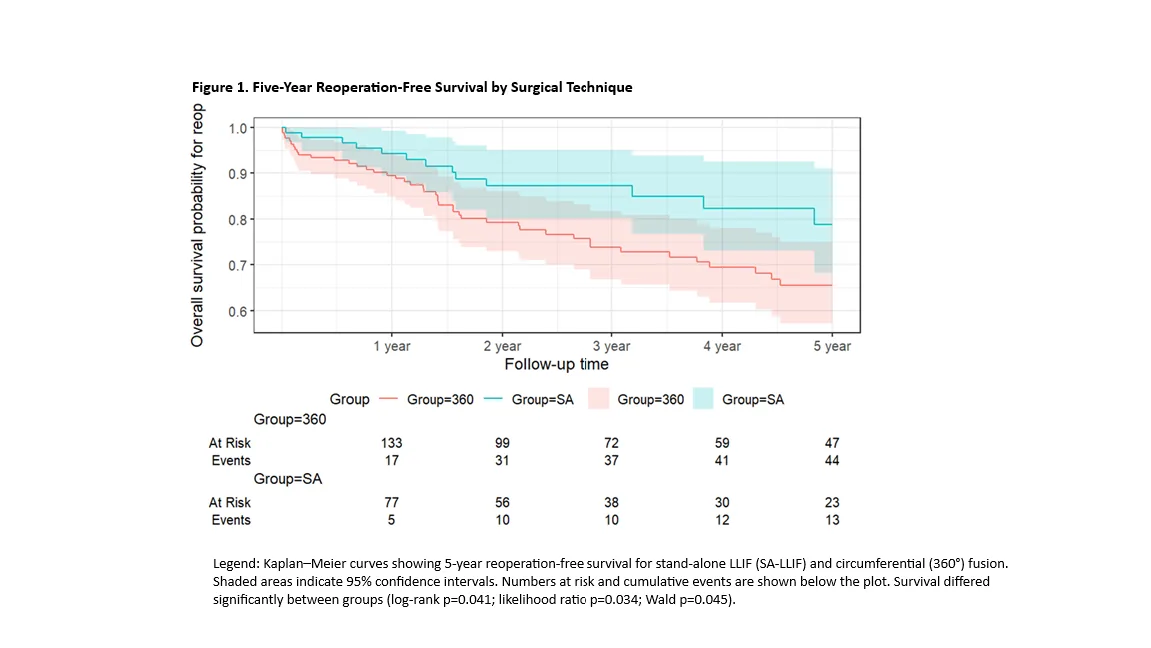
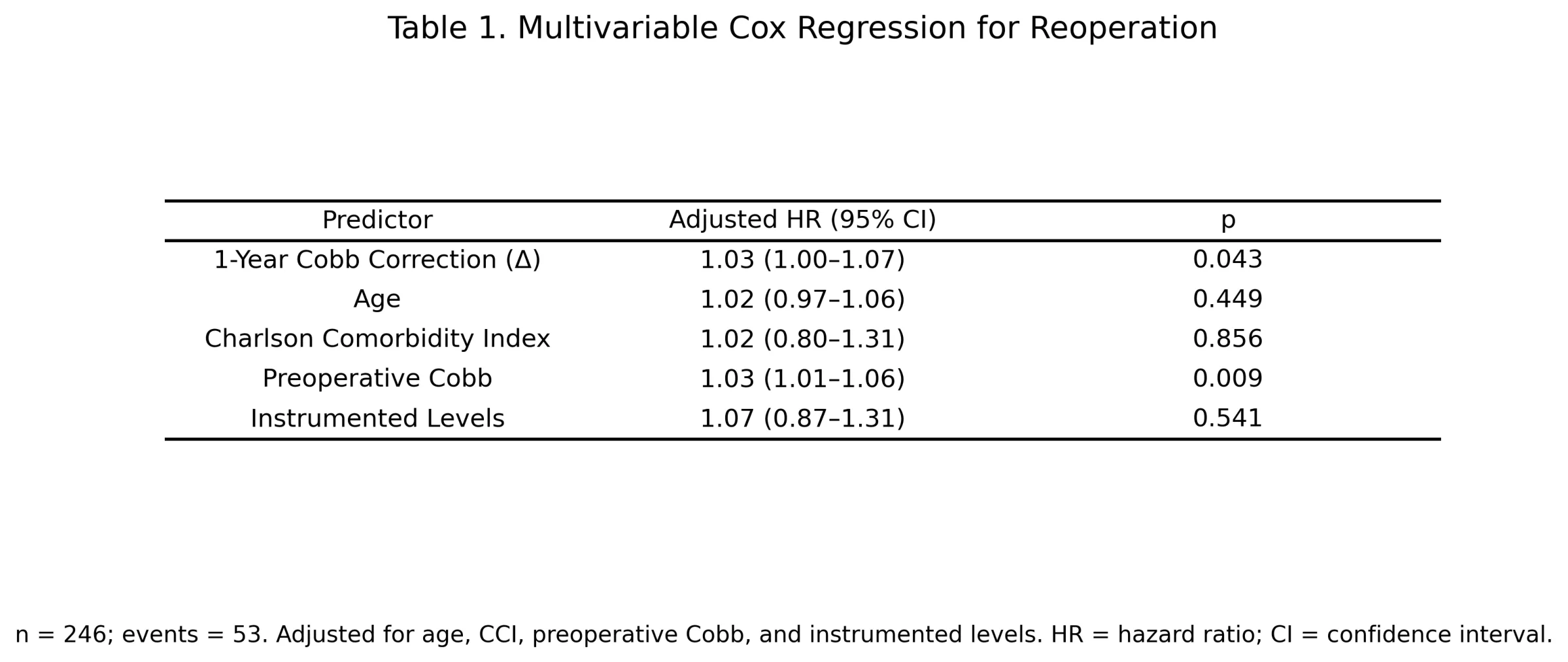
The cohort included 259 patients (SA-LLIF n=91; circumferential n=168), with 57 reoperations. Most reoperations involved extension of the index construct (68.4%), commonly related to adjacent segment disease, proximal junctional kyphosis, and hardware complications, whereas same-level revisions (31.6%) were less frequent. Early postoperative alignment was not statistically associated with reoperation. In contrast, greater 1-year Cobb correction was associated with increased reoperation risk after adjustment (HR 1.03, 95% CI 1.00–1.07; p=0.043), corresponding to an approximate 40% increase in hazard per 10° more correction at 1 year. Preoperative Cobb magnitude was also independently associated with reoperation (HR 1.034, 95% CI 1.01–1.06; p=0.008). Age, comorbidity burden, and number of instrumented levels were not independent predictors. When surgical technique and correction magnitude were included in the same model, SA-LLIF demonstrated lower reoperation risk for a comparable degree of correction (HR 0.35, 95% CI 0.16–0.74; p=0.006), while correction magnitude remained independently associated with reoperation (HR 1.05, 95% CI 1.01–1.08; p=0.007). Unadjusted survival analysis demonstrated superior 5-year reoperation-free survival for SA-LLIF compared with circumferential fusion (HR 0.53, 95% CI 0.29–0.98; log-rank p=0.041).
Greater maintained coronal correction was associated with higher reoperation risk independent of baseline deformity severity. For a similar magnitude of correction, stand-alone constructs demonstrated lower reoperation rates than circumferential fusion. These findings suggest that both correction magnitude and construct characteristics may influence postoperative durability and should be considered during surgical planning.
Figures and tables
As submitted with the abstract. Tap a figure to open it at full size.